

You’re shipping a freeze‑sensitive oncology therapy drug to a specialty pharmacy. The packaging is validated, and you’ve done everything “by the book”, but you still need an operationally simple way to flag potential temperature excursions during distribution, and you need the recipient to know what to do at receiving. The right freeze indicator is the one that fits how your shipment moves, where decisions get made, and what your stability data requires.
Three products, different operational windows
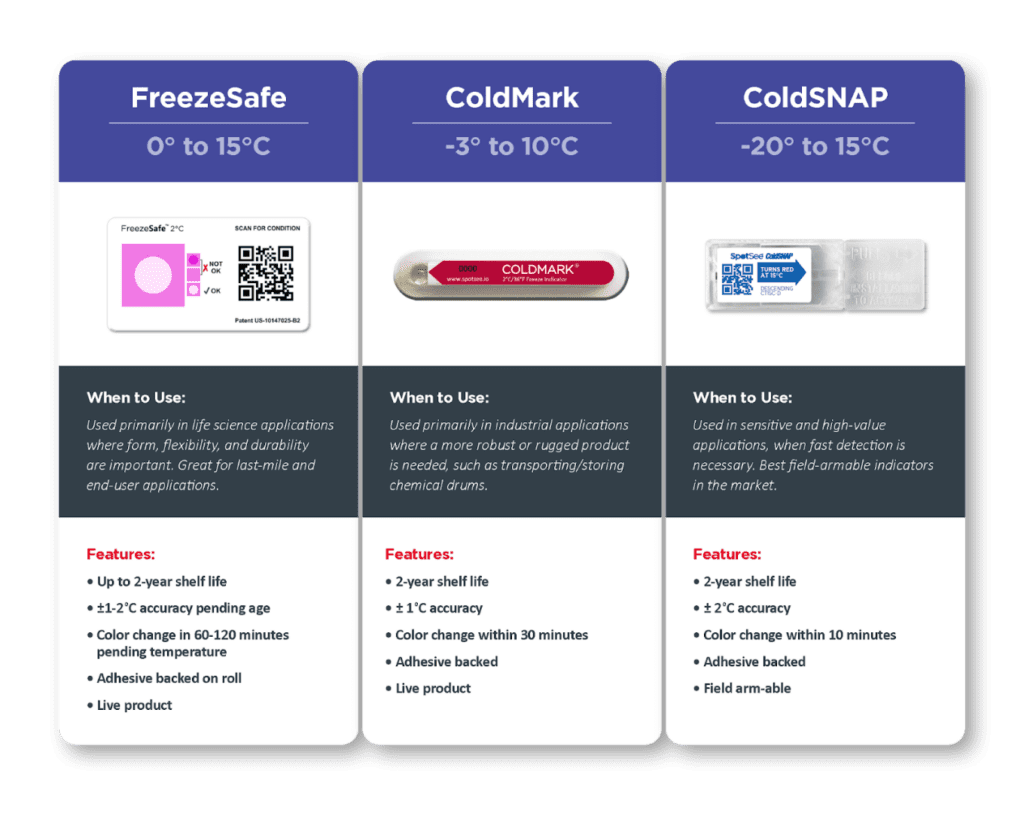
SpotSee offers three freeze temperature indicators, each designed for different operational requirements:
FreezeSafe QR responds in 60-120 minutes with ±1-2°C accuracy. It’s the most cost-focused option with a flexible adhesive form factor and up to 2-year shelf life.
ColdMark triggers within 30 minutes at ±1°C accuracy. The most rugged option, it is built primarily for industrial applications, offering mid-tier pricing with a 2-year shelf life and adhesive backing.
ColdSNAP activates in 10 minutes with ±2°C accuracy. Designed for life sciences applications, it’s field arm-able, offers clear on/off visual confirmation, making it a strong fit for high-value, high-risk, or fast-handoff workflows where rapid, unambiguous receiving decisions matter.
The practical takeaway: you don’t select a freeze indicator on a single dimension. You evaluate the decision window, accuracy needs, activation/functional fit, durability/handling realities, operational integration (SOPs), and then pick the indicator that best matches your scenario.
Response time drives operational value
Consider a scenario common in specialty pharmacy operations: an oncology therapy moves from a courier vehicle to a pharmacy receiving in a 15-minute handoff window. The receiving team needs to accept or reject the shipment before the courier leaves.
ColdSNAP detects freeze exposure during that 15-minute transfer. ColdMark will trigger 15 minutes after the decision must be made. FreezeSafe won’t respond until 45-105 minutes after the courier has already departed.
This isn’t a quality difference; it’s an operational mismatch. When your decision window is shorter than the indicator’s response time, detection comes too late to be actionable.
One common misconception: faster response is always better. If your distribution includes 4-hour legs between defined inspection checkpoints, FreezeSafe’s 60-120 minute window is operationally sufficient and more cost-effective. Fast response has value only when your workflow demands it.
Accuracy requirements come from stability data
Your product’s stability data, not the indicator manufacturer’s spec sheet, defines acceptable accuracy.
ColdMark‘s ±1°C accuracy suits products with narrow freeze-point margins or stringent stability protocols. If your biologic’s freeze threshold sits at -1°C with minimal tolerance, that precision matters.
ColdSNAP‘s ±2°C accuracy works when speed takes priority over precision within an acceptable tolerance band. For products stable down to -3°C, the two-degree window may be operationally adequate.
FreezeSafe QR‘s ±1-2°C accuracy fits applications with wider tolerance or where cost optimization is the primary driver.
These indicators complement validated packaging and continuous data loggers;, they do not replace them. Freeze indicators provide point-of-decision visibility as part of a layered monitoring strategy.
Activation method fits workflow structure
FreezeSafe and ColdMark are live products: monitoring begins at the origin. This works well for centralized distribution, where products ship directly from a single controlled facility.
ColdSNAP is field arm-able: you activate it at any point in the cold chain. This capability becomes operationally critical in specific workflows.
Consider a regional specialty hub that receives bulk shipments of cell therapies, then repackages them for individual clinic deliveries. The original shipper’s indicators monitored origin-to-hub. But the high-risk leg is hub-to-clinic, often handled by local couriers in variable conditions.
With ColdSNAP, the hub can apply and activate fresh indicators for each outbound clinic shipment. Live-only indicators would require hub staff to store active inventory (consuming their monitoring window) or ship without final-mile visibility.
A second misconception: field activation adds unnecessary cost. In consolidation and repackaging workflows, field activation can prevent double-monitoring and ensures indicators are fresh for the highest-risk distribution segment.
Practical selection criteria
Choose ColdSNAP when:
- Decision windows fall under 20 minutes (courier handoffs, rapid clinic transfers)
- Field activation aligns with your workflow (regional hubs, repackaging operations)
- Product value justifies premium monitoring (cell therapies, gene therapies, high-value biologics)
Choose ColdMark when:
- Stability data requires ±1°C accuracy
- Standard distribution provides 30+ minutes between decision points
- Industrial cold chain or warehouse operations drive use cases
Choose FreezeSafe QR when:
- Transit legs exceed 2 hours with defined inspection checkpoints
- Dual monitoring with WarmMark is operationally beneficial
- Cost optimization or product flexibility (smallest form factor) is the primary concern

Your decision framework
Before selecting an indicator, answer four questions:
What’s your shortest decision window where freeze detection matters? Measure courier handoffs, receiving processes, and inspection intervals. Your indicator must respond faster than your quickest decision point.
What accuracy does your stability data require? Review freeze thresholds and tolerance bands. Match indicator precision to product specifications, not to the tightest available spec.
Where does monitoring need to begin in your workflow? If monitoring starts at origin and stays linear, live products work. If you custom package, repackage, consolidate, or need specialized visibility, field activation becomes relevant.
What’s your cost per prevented bad acceptance versus cost per indicator? A rejected high-value oncology therapy may justify premium indicators. A lower-value diagnostic kit may not.
The real selection driver
We’ve seen quality teams select freeze indicators based solely on procurement pricing, only to discover their 20-minute receiving process couldn’t accommodate 60-minute response indicators. The result: returned product, quality investigations, and patient care delays.
One counterargument: can’t we just extend our receiving window to match slower indicators? Technically, yes. Operationally, this shifts costs elsewhere: longer courier wait times, increased labor, delayed patient access. The indicator should serve your operational model, not dictate it.
Next step
For your most freeze-sensitive shipments, run a quick selection check that weighs (1) the receiving decision window, (2) stability-driven accuracy needs, (3) workflow functionality (live vs. field arm-able, clarity at receiving), and (4) total cost impact (indicator spend plus investigation/returns/service impacts). That combination will tell you whether FreezeSafe QR, ColdMark, or ColdSNAP are the best operational fit.
You might also like:


