

A $400,000 server rack arrives at your loading dock in seemingly flawless packaging, but you still have no way of knowing whether it sustained damage during its journey.
Industry estimates show that in-transit damage costs American businesses about $1 billion per year in lost product value and related operating losses. Most operations teams make receiving decisions based on external inspection alone. That approach creates risk when a single rack contains dense GPU configurations and every delay cascades across deployment timelines.
The transport visibility gap in AI infrastructure deployment
Transport can introduce shocks and environmental fluctuations that compromise equipment before it ever reaches the receiving dock, but teams only get to evaluate condition at the point of acceptance.
Server racks now contain $200,000 to $500,000 in dense GPU and storage configurations. According to McKinsey, average rack power density has more than doubled from roughly 8 kW to 17 kW in two years and could rise to as much as 30 kW per rack by 2027 due to increasing AI compute demands. CBRE notes that AI-focused data centers demand significantly higher power density per rack than traditional facilities, often more than twice the typical requirements. Industry research such as the Uptime Institute’s 2025 Global Data Center Survey reports that data center operators are expanding and modernizing to meet rising power and density requirements driven by AI, with many facilities working to support racks in increasingly higher power brackets.
When these assemblies arrive, receiving teams face three options: unpack and test everything (days of delay), install without inspection (risk failures during commissioning), or apply judgment based on external inspection.
These assemblies don’t fit in conventional packaging. Protection depends on crating and securing methods that provide no condition feedback. The journey between factory and data center is where damage occurs, but it’s discovered only after acceptance decisions are made.
Why receiving decisions matter in compressed timelines
AI project timelines are compressed. Equipment delays cascade across deployments.
Receiving teams need objective triggers to inspect, not guesswork. Documentation requirements start at shipping, not after problems appear.
Accountability shifts at every hand-off: factory to freight, freight to staging, staging to installation. Without condition data at transfer points, disputes lack clear evidence and operations teams absorb costs without recourse.
How monitoring works at decision points
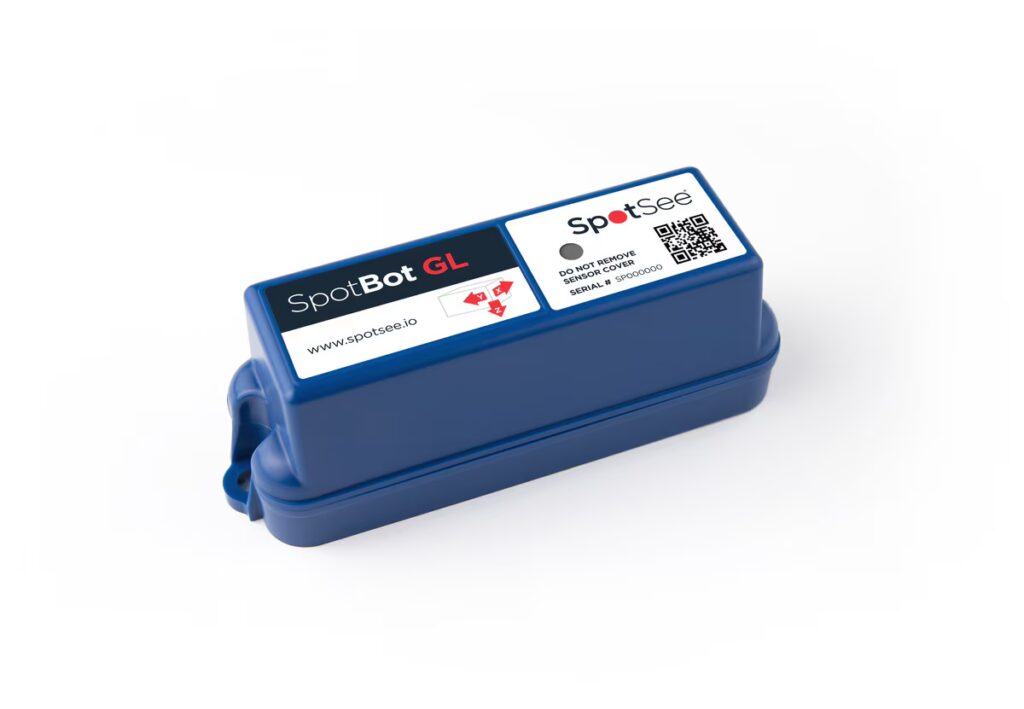
SpotBot GL tracks tri-axial impact, temperature, humidity, and location throughout transport and staging. Users define thresholds for their equipment types. When excursions occur, the system delivers alerts.
The device monitors impact from 3G to 100G across three axes. Temperature range spans -20°C to 60°C. Humidity monitoring covers 10% to 90% RH. Communication occurs via 4G LTE, 2G, and Wi-Fi across global networks. Battery life ranges from six months to 4.5 years depending on reporting interval. The IP67-rated case handles transport conditions.
Users access condition data through a secure cloud platform before accepting delivery. They review incident timelines to identify when and where excursions occurred.
SpotBot GL provides operational visibility. It answers the question: what happened during transport, and does that trigger inspection before acceptance?
What users do with condition data
At receiving: Check cloud platform data before signing for delivery. Review documented excursions while the carrier is present. Make acceptance decisions based on threshold data rather than visual inspection alone.
During staging: Monitor environmental conditions during hold periods. Verify that temperature and humidity remain within acceptable ranges before installation.
Pre-installation: Review incident records before work begins. Make go or no-go decisions based on objective data.
Hand-off accountability: Document condition at transfer points through cloud-recorded data. Create accountability across logistics networks and third-party carriers.
One of the largest AI data storage companies uses a SpotBot device on every new server rack for operational visibility. The company needed objective data at receiving to inform inspection decisions without delaying deployments.
Practical application across infrastructure segments
Server rack transport: Dense GPU configurations during data center buildouts require impact and environmental monitoring through factory-to-facility journeys.
Energy storage systems: Battery and power distribution equipment for AI facilities face impact and temperature sensitivities during transport.
Modular data center deployment: Pre-assembled units crossing multiple hand-off points need continuous condition visibility.
Staging and installation: Extended hold periods between delivery and installation require environmental monitoring before work begins.
What operational monitoring provides
Operational monitoring provides condition visibility during transport and staging. It creates accountability across distributed logistics networks. It supports receiving and hand-off decisions.
The system delivers threshold alerts to operations managers, receiving supervisors, and installation coordinators before acceptance decisions are made. It generates cloud-based documentation for quality investigations and carrier disputes.
This is actionable data at decision moments.
A common misconception: external inspection is sufficient
Many operations teams rely on external crate inspection and carrier reputation for risk management.
Impact events rarely damage crating in visible ways. A significant shock can affect internal components while leaving the exterior intact. Environmental excursions during staging often occur after the carrier has left. By the time problems surface during commissioning, accountability has dissolved and timelines have slipped.
External inspection indicates the crate survived. Condition monitoring indicates whether the equipment inside experienced potential damage.
Why monitoring complements handling procedures
Better packaging and handling procedures reduce transport risk. In practice, AI infrastructure transport involves third-party carriers, multi-modal journeys, and hand-offs across organizations with different standards.
Condition monitoring does not replace packaging or handling procedures. It provides operational visibility to make informed decisions when handling doesn’t go according to plan or when you need objective evidence at acceptance.
Integration into receiving procedures
Program impact and environmental thresholds for your equipment types. Add monitoring checkpoints to receiving SOPs. Train receiving staff on threshold alert response.
Establish documentation review workflows for quality investigations and carrier disputes. Set up alert notifications for different stakeholder roles. Create data review procedures before sign-off at each hand-off point.
SpotBot GL supports customizable alert notifications through the cloud platform. Users configure thresholds based on equipment specifications and operational requirements. The system logs all threshold excursions with timestamps and location data.
Most operations start with pilot deployments on high-value or time-sensitive shipments, document baseline excursion rates, then scale based on operational impact.
Implementation approach
Review your current receiving visibility. What triggers inspection decisions today?
Pilot monitoring on high-value shipments. Document what percentage of shipments exceed thresholds. Use that baseline to inform decisions about scaling monitoring across additional equipment types or routes.
Operations teams often discover more transport risk than expected. Early detection at receiving costs less than discovering failures during commissioning.
Next steps
Assess your current receiving procedures. If inspection decisions rely on visual examination and carrier reputation, you’re making acceptance decisions without condition data.
Start with a pilot deployment on your next high-value shipment. Review the data at receiving. Document whether excursions occurred and whether that data would have changed your acceptance decision.
The question isn’t whether transport damage happens. It’s whether you have visibility to make informed decisions before that damage becomes your operational problem.
Scale based on what you learn. Most operations find that objective condition data at receiving reduces risk, improves accountability with carriers, and supports faster resolution when problems occur.
—
You might also like:


