

Your dishwasher display says 160°F, but can you prove the dishware surface actually reached that temperature?
The documentation gap that auditors look for
Imagine a hospital nutrition services manager points to a dishwasher’s digital display showing a final rinse temperature of 171°F. On paper, that looks compliant.
Now imagine an auditor asks for surface temperature records from last month’s disinfection cycles. The conversation slows.
The dishwasher display shows chamber temperature. The dishware surface may tell a different story. And that gap is exactly what auditors are trained to look for.
Under FDA Food Code Section 4-703.11, hot water mechanical dishwashing requires verification that utensil surfaces reach 71°C (160°F) using an irreversible registering temperature indicator. Not the chamber temperature. Not the spray arm reading. The utensil surface itself.
Most commercial dishwashers report internal chamber temperature. These readings confirm that the equipment is operating as intended. What they do not verify is heat transfer to the dishware surface, especially when racks are fully loaded, items are nested, or spray patterns are partially obstructed.
During an audit, regulators are looking for permanent documentation that surface temperatures were achieved. Machine logs and dial thermometer readings document equipment operation. They do not provide disinfection verification.
Another common point of confusion is the difference between disinfection and sanitization. Chemical sanitization using chlorine, iodine, or quaternary ammonium compounds relies on concentration and contact time at lower temperatures. Hot water disinfection requires sustained surface contact at a minimum of 160°F, which makes surface temperature verification essential rather than assumed.
Why surface temperature is what actually matters
Heat transfer isn’t instantaneous. A dishwasher chamber reaching 165°F doesn’t guarantee that every surface on every item reaches the 160°F threshold during the cycle.
Dishware materials, load density, item orientation, and spray coverage patterns all affect whether surfaces achieve disinfection temperature. Stacked trays, nested bowls, and items placed at rack edges or in spray shadows might not reach the threshold, even when the machine performs to specification.
This is why the FDA Food Code specifically calls for irreversible registering indicators. These devices permanently record the maximum temperature reached and cannot be reset or altered afterward. They provide objective, tamper-proof evidence that a specific surface achieved the required thermal exposure during that particular cycle.
The 71°C/160°F threshold supports validated microbial reduction for proper disinfection. It’s the benchmark that matters in food service and healthcare environments where chemical residues aren’t appropriate for everyday use.
Meeting this requirement means verifying temperature at the surface, where contamination exists and where disinfection must occur.
How ThermoStrip DL helps close that gap
ThermoStrip DL is a waterproof, self-adhering temperature indicator that changes irreversibly from white to black when the surface reaches 71°C (160°F).
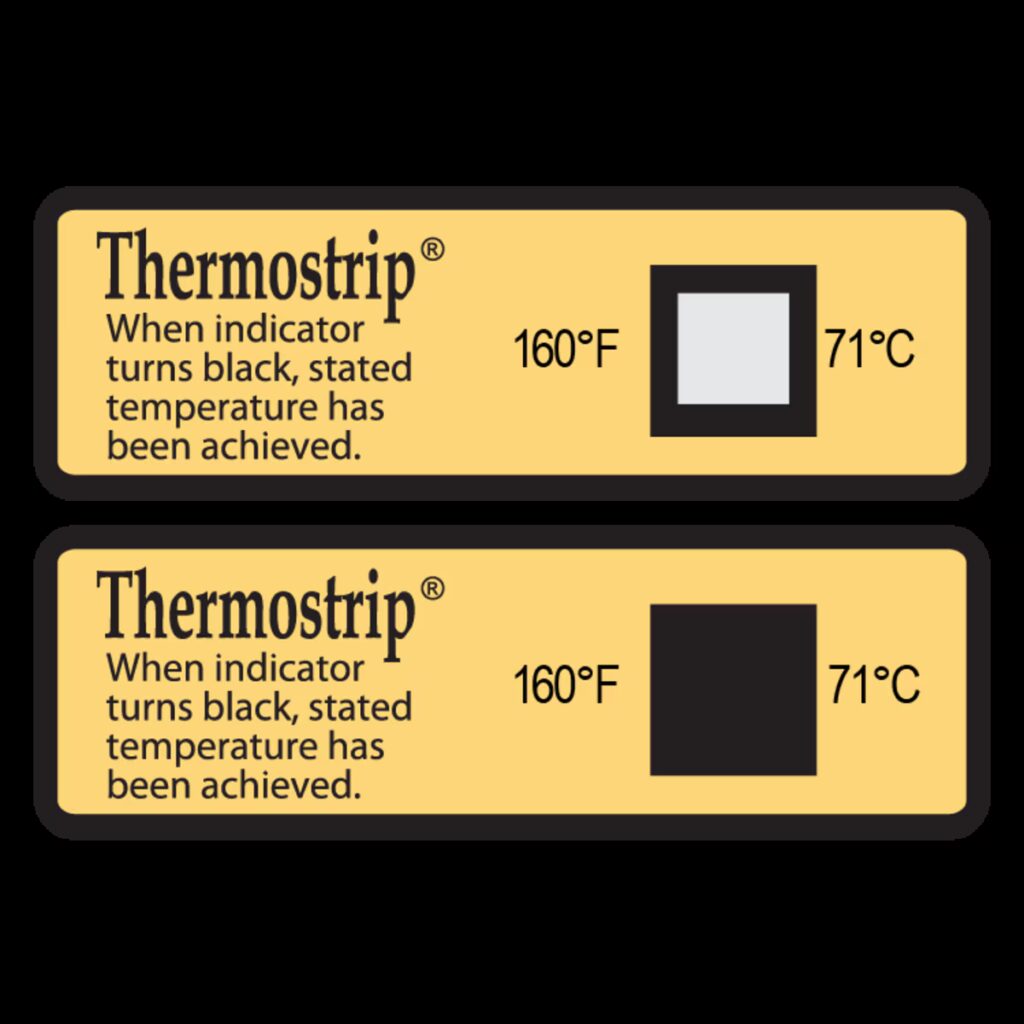
Once activated, that color change is permanent. You have a visual, dateable record showing that the surface achieved disinfection temperature during that specific cycle, which directly aligns with FDA Food Code Section 4-703.11 requirements.
The indicator adheres directly to dishware, trays, or utensils and stays in place throughout the entire wash and rinse cycles. After the cycle completes, the indicator shows either full activation (black, indicating the surface reached 160°F or higher) or partial or no activation (white or gray, indicating insufficient temperature).
ThermoStrip DL complements your already-validated dishwashing process. It does not replace equipment validation. What it provides is operational visibility, confirmation that your validated process is performing as intended during routine use.
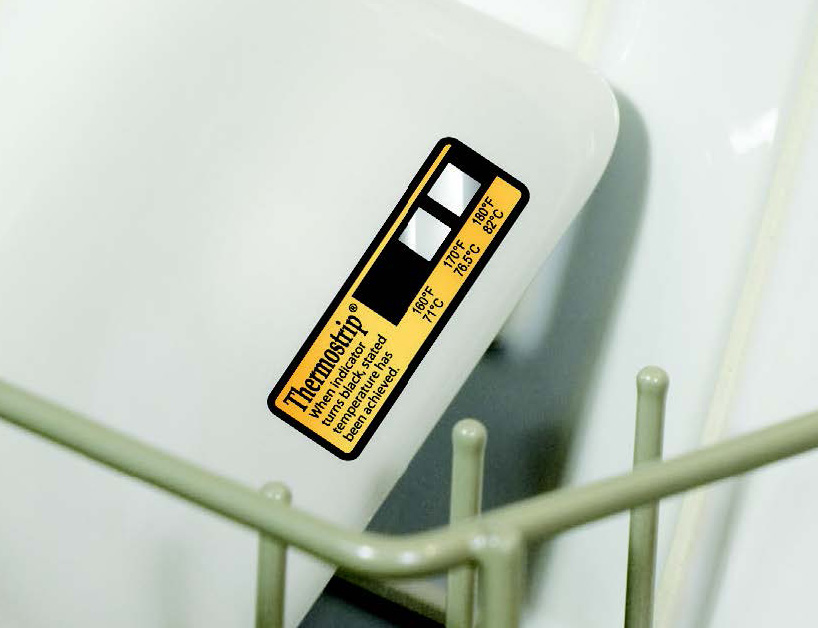
The operational advantage is placement flexibility. In packed dishwashers, you can apply indicators to multiple items throughout the load: top rack, middle, bottom, front, back, and center positions. This approach reveals whether your entire load achieves uniform disinfection or whether specific zones consistently underperform.
If indicators on the top rack consistently show full activation but bottom-rack indicators come out white, you’ve identified an uneven heating pattern that machine displays would never reveal. That’s actionable information for maintenance scheduling, load reconfiguration, or process adjustments.
Using multiple indicators across different rack positions confirms that even packed machines achieve full disinfection coverage, not just adequate chamber temperature.
Making it work within your HACCP program
In most HACCP-based food safety programs, dishware disinfection is designated as a Critical Control Point (CCP). CCP monitoring must demonstrate that critical limits, in this case that 160°F surface temperature, are being consistently met cycle after cycle.
ThermoStrip DL fits naturally into CCP monitoring workflows. Apply indicators to representative items in each cycle, or follow a defined schedule: every cycle, every shift, or daily, based on what your hazard analysis determines. After the cycle completes, visually verify whether the indicators activated. Record the results in your CCP log along with date, time, cycle number, and indicator result.
For audit readiness, retain the activated indicators as physical records. Attach them to log sheets, photograph them with batch identifiers visible, or store them in a dedicated compliance binder indexed by date. These become your objective evidence that surface disinfection temperatures were achieved and properly verified.
When an indicator shows non-conformance, staying white or only partially activated, your HACCP plan should have defined corrective actions: re-wash that entire load, inspect and test the dishwasher, check rack loading, and document both the corrective action and verification steps before resuming normal operations.
Non-conformance is early detection. It gives you the opportunity to address process drift before it becomes an actual contamination event or an audit finding that could affect your operation.
What this looks like in the real world
In a hypothetical hospital food service operation, a nutrition services team implements ThermoStrip DL after an auditor raises questions about how dishware surface temperatures are being verified.
As part of the process, one irreversible indicator is applied per tray rack and positioned centrally on the top tray. Over a two-week period, most indicators show full activation. A small subset, all from the same rack position, show only partial activation.
This triggers a maintenance review. The team identifies a partially clogged spray arm affecting that zone. After cleaning the spray arm and retesting with fresh indicators, all racks achieve full activation.
The indicator results, along with the documented corrective action and follow-up verification, are added to the facility’s audit-ready CCP records, demonstrating process control during inspection.
In a separate hypothetical long-term care facility, the nutrition services department uses ThermoStrip DL during both morning and evening dishwashing cycles. Indicators are applied to a plate, bowl, and cup in each load. Activated indicators are dated, logged, and stored monthly in the facility’s compliance file.
During a routine health department inspection, the inspector reviews several months of indicator records and notes the facility’s proactive approach to surface temperature verification as part of its overall compliance program.
Your next steps: Building documentation before you need it
Review your current surface temperature documentation practices. If you’re relying solely on machine displays or chamber thermometers, you likely have a documentation gap.
Test your actual process using ThermoStrip DL across multiple rack positions and various load configurations. This will identify whether your dishwasher achieves uniform surface temperatures throughout the chamber or whether certain positions consistently underperform.
Build your record-keeping system before the audit arrives. Define where you’ll place indicators, how frequently you’ll use them, what documentation format works for your operation, and what triggers corrective actions. Train your team on application technique and how to interpret results correctly.
Consider requesting samples to validate your current disinfection process and establish a baseline for compliance documentation. Surface disinfection temperature verification is an FDA requirement and a fundamental operational component of food safety in healthcare and institutional settings.
—
You may also like:
● Elevate disinfection standards with ThermoStrip technology
● Donor milk temperature monitoring made simple with WarmMark


