

When a shipment contains something truly irreplaceable (think biologics, diagnostic materials, or time-critical medical supplies from equipment to transplant organs), “we’ll sort it out later” isn’t an operational option. You need a clear temperature excursion signal the moment the package is opened.
The gap between “temperature history” and real-world decisions
In many cold-chain and medical scenarios, the most consequential decision happens at the hand-off: receiving, transfer, or point-of-care. That’s when teams need to decide whether to proceed, quarantine, or escalate, often with limited time and limited tolerance for ambiguity.
For freeze-sensitive shipments such as heart valves, transplant-related materials, or tissue samples, an immediate understanding of whether freezing conditions occurred can be operationally necessary. A visible freeze indicator included in the package can provide that confirmation at the point of decision, without interpretation, downloads, or specialized tools.
ColdSNAP indicators are designed for this operational gap: the moment when your team opens the package and needs to know whether freezing conditions occurred. Indicators complement validated packaging, they do not replace it.
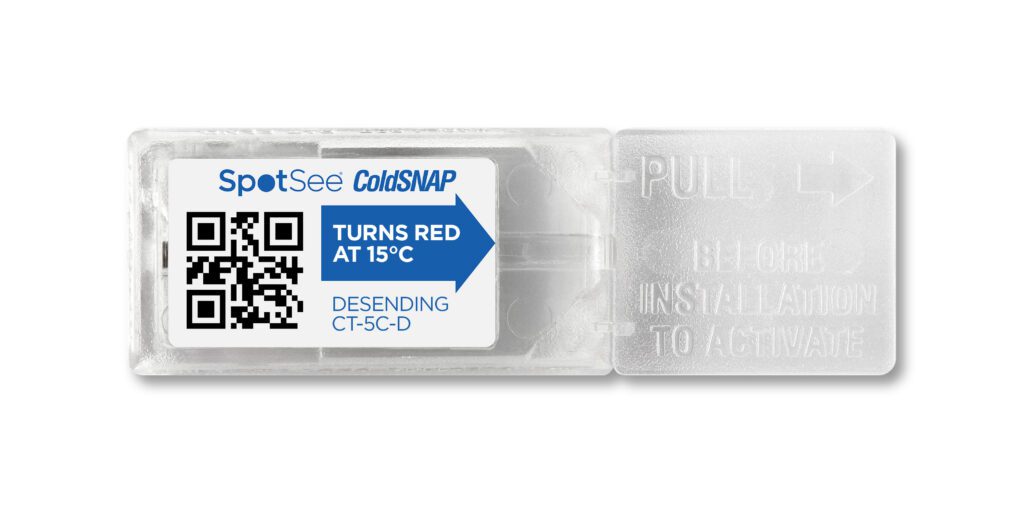
How ColdSNAP mechanical indication works
ColdSNAP uses a mechanical indication system housed entirely in plastic. When the ambient temperature drops below the indicator’s rated threshold, the clear plastic drops a red disc that cannot retract.
The mechanical operation requires no batteries and no electronics. The all-plastic construction contains no glass and no chemical reagents. Each indicator has a self-adhesive backing for direct application to packaging surfaces.
ColdSNAP models are available with temperature thresholds ranging from -20°C to +15°C, with ±2°C accuracy. This range allows you to select the threshold that matches your product’s freeze sensitivity and operational requirements.
Because the indication is permanent and mechanical, there is no risk of electronic failure, battery depletion, or product degradation during storage or transport.
Field-armable application fits variable workflows
Many cold chain and medical operations involve consolidation, repackaging, or custom distribution steps where products change hands multiple times.
ColdSNAP’s field-armable design supports these variable workflows. Indicators can be applied at custom facilities, at consolidation points before shipments, or by receiving staff before short-distance transport to satellite facilities.
For OEM packaging applications, ColdSNAP can be integrated directly into product packaging, providing freeze indication from the point of manufacture through final delivery. The indicators require no special storage conditions before application and no activation equipment.
This flexibility may support operations where products move through clinical or medical distribution networks, diagnostic lab networks, or research supply chains with multiple handoff points.
Construction designed for medical environments
The all-plastic housing of ColdSNAP reduces contamination concerns compared to glass vial indicators. There are no fragile components that could break during handling, and no chemical reagents that would require hazmat documentation or special disposal procedures.
For applications with stringent material requirements, biologics packaging for clinical trials, medical device or organ transfer, or research samples moving between facilities, the chemical-free construction may better suit your documentation and handling protocols.
The construction is not sterile and indicators are not approved for direct product contact. The all-plastic design eliminates certain compliance documentation steps and may reduce material compatibility concerns during the packaging design process.
ColdSNAP as part of a monitoring strategy
Visual indicators do not compete with data loggers or validated monitoring systems.
What ColdSNAP provides:
- Visual freeze indication is visible at package opening
- Immediate operational visibility for receiving decisions
- Clear yes/no signal that requires no data analysis or download equipment
Data loggers provide:
- Validated continuous temperature monitoring
- Data logger compliance documentation
- Qualified packaging validation studies
- Internal product temperature confirmation (surface-mounted indicators show ambient exposure, not product core temperature)
Used together, indicators provide immediate decision support at receiving, while data loggers provide validated temperature records for quality review and deviation investigations.
The indicator answers the operational question: Did this package experience freezing conditions? The data logger provides a validated temperature history for compliance review.
Where ColdSNAP delivers the most operational value
ColdSNAP delivers the strongest operational value in scenarios where:
- Receiving decisions happen before the data logger download and analysis
- Products move through consolidation or repackaging steps
- Final delivery to clinics or research sites requires immediate verification
- Product value justifies layered monitoring approaches
- Material specifications require chemical-free construction
- Multiple handoff points benefit from consistent visual confirmation
In time-critical medical logistics, where coordination is scheduled, the chain of custody is tightly managed, and the shipment may be uniquely sensitive, having a clear temperature excursion indication at the moment of transfer can support faster escalation and clearer communication between shipping and receiving teams.

Practical visibility for freeze-sensitive operations
ColdSNAP indicators provide operational clarity at the moments when receiving teams make decisions: immediately, at package opening, and at handoff between facilities.
They work alongside validated monitoring systems by answering the immediate question: Did this package experience freezing conditions?
For operations handling biologics, organs, medical devices, or other freeze-sensitive materials, where operational visibility supports faster receiving decisions and clearer communication between shipping and receiving teams.
Next step: Review ColdSNAP specifications, temperature threshold models, and application guidance at spotsee.io to determine which configuration fits your operational requirements.
—
You might also like:


