

Your process chart can look perfect and still fail the simplest audit question: what did this specific unit actually experience temperature-wise?
Process documentation can be complete, validated and well controlled, yet still fall short when the question shifts from process performance to unit-level reality. At audit time, or during a warranty or investigation review, the focus narrows quickly to one component. What did this specific unit experience?
The position is straightforward. Batch records are not always sufficient for unit decisions.
Why batch records fall short for unit-level decisions
Industrial operations often have strong batch and process documentation. Oven charts, SCADA trends and batch logs describe how the system performed. They support process control and validation.
What they do not reliably provide is proof of what one individual unit experienced at its surface.
This gap appears when a question becomes specific:
- Did this part actually reach the required minimum temperature
- Was this unit exposed to an over-temperature event during handling or rework
- Can this returned item be tied to temperature excursion evidence
Batch records describe the system. They do not always resolve the condition of an individual unit once it moves downstream.
If the question is at unit level, the evidence needs to be as well.
The documentation gap that shows up later
Most teams already collect temperature data. The issue is not volume, it is attribution and retrieval.
Common patterns appear in audits and investigations:
- The process reached setpoint, but there is no proof the part did
- A temperature excursion is suspected, but affected units cannot be identified
- Documentation is complete at batch level, but not tied to the returned item
This creates a familiar situation. The process looks controlled, but the unit cannot be definitively accepted or rejected based on available evidence.

What unit-level evidence actually looks like
For operations and quality teams, effective evidence shares a few characteristics:
- It is attached to the specific component or container
- It is readable at a glance
- It is irreversible and cannot reset after the event
- It is retainable and can be stored with inspection records
Retention is often overlooked. If evidence cannot travel with the unit’s documentation, it tends to disappear as items move across shifts, sites or stakeholders.
How Thermax creates retrievable peak-temperature proof
Thermax irreversible temperature indicators provide a permanent record that a surface reached or exceeded a defined temperature.
Each indicator contains temperature-sensitive elements sealed within heat-resistant materials. When a threshold is exceeded, the element changes color. That change is irreversible, preserving the event.
Two aspects make this operationally useful:
- Peak temperature focus, confirming that a threshold was reached rather than attempting to record a full profile
- Stepped indication, where multi-element indicators show multiple thresholds and the highest temperature achieved
This allows teams to quickly determine whether a minimum requirement was met or whether a maximum limit was exceeded.
Thermax indicators are self-adhesive, require no activation and are designed to withstand industrial environments, including exposure to oil, water, and steam.
Where this fits in operations
Thermax is most effective when used as a unit-attached artifact at defined checkpoints:
- Receiving and hand-off inspections
- Maintenance, rebuild and teardown workflows
- Warranty and return investigations
- Process validation support where unit-level confirmation is required
It is important to keep the role clear.
- It is not a data logger
- It does not replace calibrated instrumentation or process controls
- It does not provide dwell time or full temperature history
It strengthens traceability at the unit level when batch documentation alone cannot answer unit-specific questions.
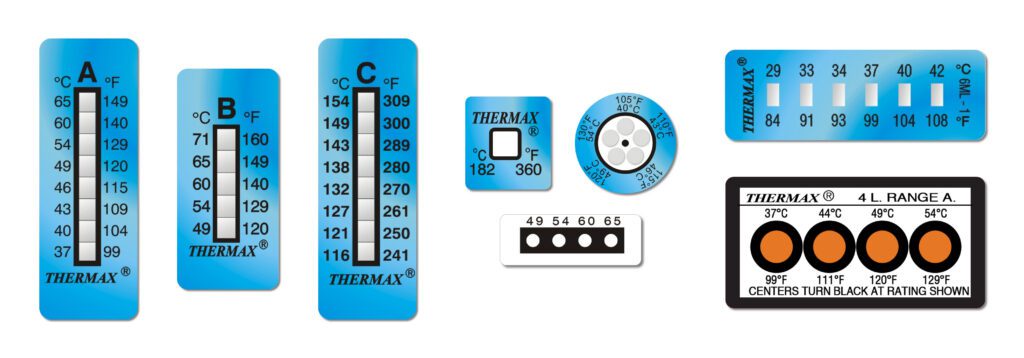
Turning peak temperature into an inspection artifact
The operational value comes from a repeatable workflow.
- Apply the indicator to a surface that represents the relevant thermal risk
- Define the inspection point, such as post-process, pre-ship or receiving
- Record the observed state against the unit ID
- Retain the indicator as part of the inspection record
Because the indicator can be removed and attached to documentation, it becomes part of the unit’s record rather than a transient observation.
This creates a chain of evidence that remains accessible when questions arise later.
Example scenario: rail component inspection
In rail maintenance and rebuild environments, components move through multiple handling stages where quick, reliable checks are required.
A unit-attached indicator supports at-a-glance inspection and can be retained with the inspection record. The irreversible color change ensures that the result remains visible and consistent over time.
The broader point applies across industries. When a component crosses boundaries or re-enters service, teams need evidence that travels with it.
Why process logs are not enough on their own
Process logs remain essential. They describe how the system behaved and support overall control.
The limitation appears when:
- The unit is separated from the batch
- The question arises weeks or months later
- The investigation focuses on a single item
In those cases, unit-attached evidence complements process data. One explains the system. The other resolves the unit.
Selecting thresholds without overcomplication
Implementation is most effective when aligned with decisions:
- Choose thresholds that match real acceptance limits
- Use single or multi-step indicators based on decision needs
- Place indicators where they reflect actual risk, not just convenience
- Define clear accept or reject criteria in SOPs, including how results are recorded and retained
The goal is not to add complexity. It is to make unit-level decisions faster and more defensible.
Conclusion
Batch documentation explains the process. Unit-level evidence resolves the unit.
When decisions depend on what a specific component experienced, attaching irreversible, retrievable evidence directly to that unit is one of the simplest ways to close the gap.
—
You might also like:


