

Cold chain monitoring often breaks down at the last-mile hand-off because the receiving check is not captured as evidence. If a clinic, laboratory, pharmacy or patient is asked to make an accept or reject decision at receipt, the workflow should also produce a clear, time-stamped record of what was observed at that moment. WarmMark QR supports that shift by prompting scan-on-receipt and creating retrievable documentation of the indicator condition at the time of receipt.
Why last-mile receiving fails the documentation test
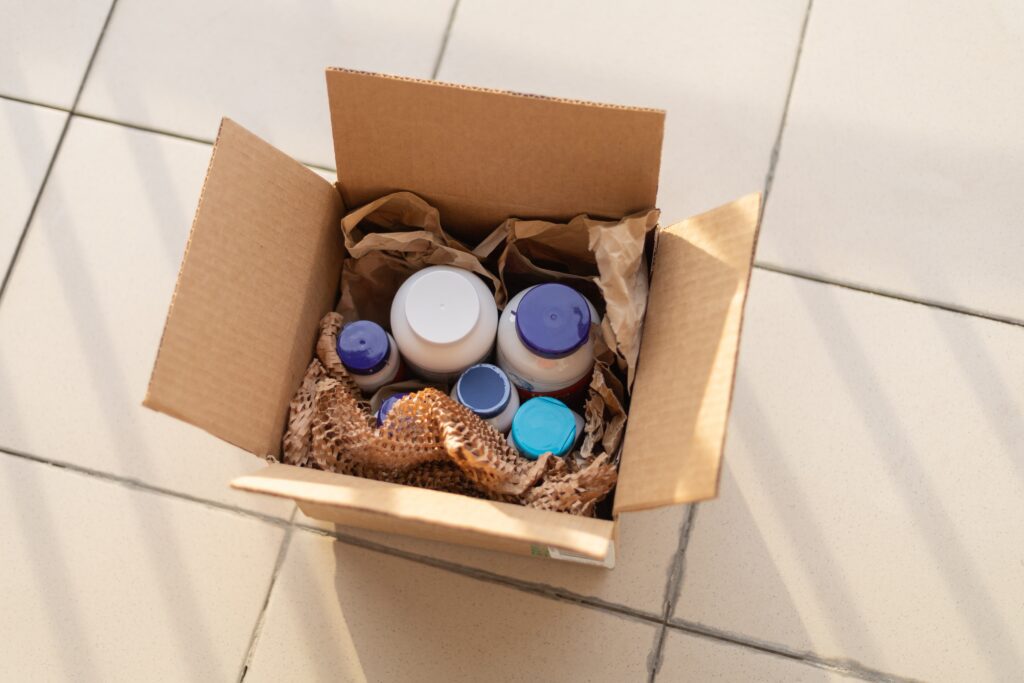
The last mile is where quality intent meets real-world execution. The receiving decision is made by the end user, not the shipper. That end user might be a clinic coordinator at a front desk, a lab technician receiving after hours, a pharmacy team managing multiple inbound deliveries, or a patient opening a ship-to-home package.
Because these hand-offs are fast, the check is often informal. Someone looks at the package, notices the indicator and moves on. Later, when QA asks what was observed at receipt, the answer is often a memory, a note or nothing at all.
This is where “return by default” behavior appears. Without a defensible, contemporaneous record, teams/patients choose the lowest-friction option, which is often to return, reship or dispute rather than triage with confidence.
A stronger approach looks different. The receiver completes a simple check and the organization can retrieve evidence later that is tied to the shipment and the exact decision moment.
What “evidence at receipt” means operationally
Evidence at receipt is a record that is:
- Concrete evidence, created at the moment of receipt
- Retrievable, easy to access during a deviation, complaint or audit
- Traceable, tied to a unique identifier rather than a generic shipment description
This matters because disposition happens at receiving. If the record is not created at that moment, quality teams are left trying to reconstruct what happened. The discussion shifts from product evaluation to documentation risk.
What WarmMark QR is, and what it is not
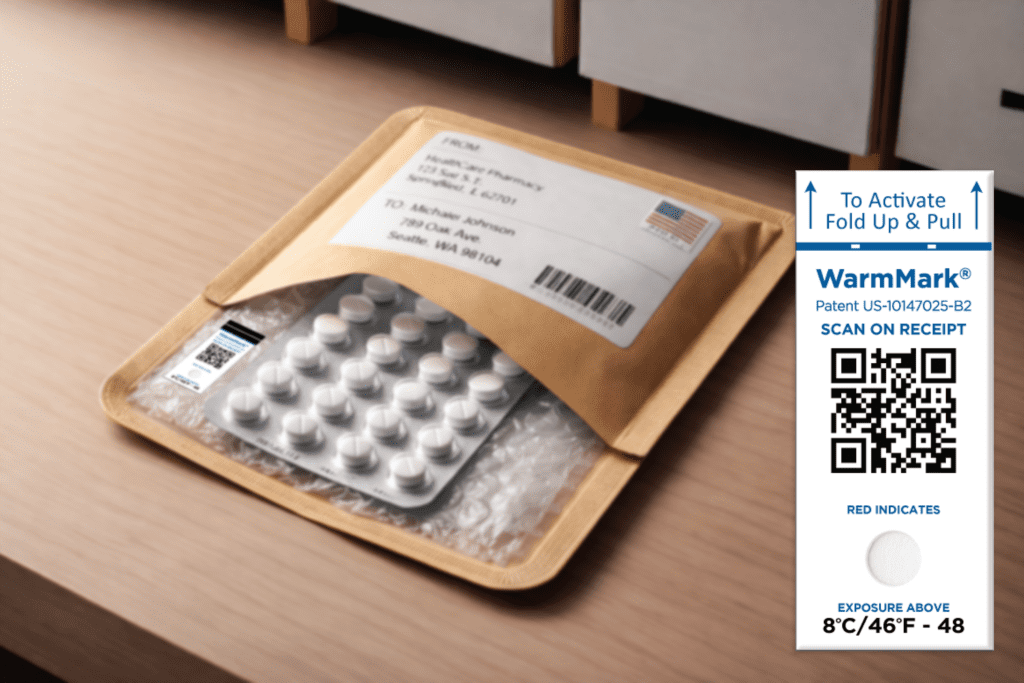
WarmMark QR is a single-use, battery-free time-over-temperature indicator designed to support last-mile receiving. The uniquely serialized indicator changes from clear to red when an unacceptably high temperature exposure has occurred. The operational advantage is the QR-enabled scan. A receiver scans the code with a smartphone camera, with no app required. The scan captures the indicator condition along with time, date, location and serial number, saving the information in a cloud record.
Two guardrails keep this approach aligned with quality expectations.
First, the scan documents the indicator’s condition at receipt. Second, WarmMark QR complements validated packaging and data loggers. It does not replace them.
How to run a scan-on-receipt process that works
If the process does not fit the reality of a clinic, laboratory, pharmacy or patient, it will not be used consistently. A practical target is a one-minute receiving routine that fits naturally into an SOP.
A simple structure:
- Inspect the shipper for visible damage or tampering
- Observe the WarmMark QR indicator and determine a good read or bad read
- Scan the QR code to create a time-stamped record of the observation
- Let the scan automatically capture the record and trigger the next step: accept, quarantine or escalate
Each step leads to the next. The observation triggers the scan, the scan creates the record and the record supports the decision. This linkage is what reduces “return by default” behavior.
How this improves audit readiness
Quality teams need records that are easy to retrieve and review. Because the scan captures time, date, location, serial number and indicator condition, teams can access the record during deviation investigations, complaint reviews, audits or partner discussions.
This supports a documentation approach aligned with traceability and record review expectations. Quality Systems teams still define how these records integrate into GDP processes, including deviation and complaint workflows.
Where WarmMark QR fits in the monitoring stack
Each tool supports a different decision:
- Validated packaging maintains temperature conditions during transit
- Data loggers provide detailed temperature history for investigation and trending
- WarmMark QR supports the receiving decision by turning a visual check into retrievable evidence
Because of this, WarmMark QR works best as a workflow layer at the hand-off. It standardizes receiving behavior while packaging and loggers provide the broader stability context.
A receiving example in practice
A ship-to-home diagnostic kit is delivered to a patient. The patient scans the QR code on receipt, not to follow an SOP, but to confirm delivery and share the condition with the shipper.
The scan creates a time-stamped record tied to the indicator serial number. If the indicator shows an excursion, the scan can trigger follow-up from the shipper, who can assess and coordinate a replacement or next steps.
The burden of interpretation shifts away from the end user and back to the organization responsible for the shipment.
Later, if a question arises, QA can retrieve the scan record to confirm what was observed and when. This does not replace a full investigation, but it removes uncertainty around the decision moment.
Practical implementation notes
Implementation is primarily about consistency.
- Define ownership between operations and quality
- Start with a small pilot at selected receiving sites
- Ensure pre-shipment scans support traceability where required
- Provide clear receiving instructions with defined routing outcomes
- Track scan compliance and refine training based on exceptions
Storage and handling should follow product guidance, including environmental conditions and any pre-conditioning requirements defined in the Instructions for Use.
FAQ
→ Do receivers need an app to scan?
No. Scanning is done using a smartphone camera with no app required.
→ Does this replace data loggers or validated packaging?
No. It complements them and supports receiving documentation.
→ What does a color change mean operationally?
It indicates exposure to an unacceptably high temperature. The appropriate response is to quarantine and escalate according to SOP, followed by investigation.
Conclusion
If the last-mile receiver cannot create evidence at receipt, the cold chain becomes harder to defend where it matters most. WarmMark QR provides a practical way to make the receiving check consistent, time-stamped and retrievable, while keeping clear roles between indicators, loggers and validated packaging.
Build the record into the receiving decision, or be prepared to reconstruct it later.
____
You might also like:


