

You did the temperature checks. But when the carts move to service, the record is incomplete, smudged, or missing.
In high-volume airline catering, temperature checks are routinely completed. What breaks under pressure is not the check itself, but the documentation that should accompany it.
During peak service, teams are balancing timing, volume, and coordination between kitchen and in-flight service. At that moment, the gap is not knowledge or discipline. It is whether the record survives the workflow.
The most practical way to improve audit-ready documentation is simple: capture proof at the same moment the decision is made, not after.
Where documentation breaks during peak service
Airline catering workflows do not stop at the kitchen. They extend through tray assembly, cart loading, transport, and in-flight reheating and service.
Because of this, documentation often separates from the food at the exact moment it matters.
Common patterns include:
- Probe readings are called out but not written down
- Logs are completed later from memory
- Paperwork does not travel with the cart or service stage
- Checks performed in-flight are not consistently recorded in a way that can be retrieved later
The issue is not measurement. It is that the decision and the record are not captured together.
The key idea: focus on decision moments
Instead of adding more measurements, focus on the points where teams must decide what happens next.
In airline catering and onboard service, those moments are clear:
- Confirm reheat has reached the minimum required temperature before service
- Approve food to move forward to trayset or service
- Decide whether to continue hot hold, reheat, or remove from service
At each of these points, the team needs a defensible answer to a simple question: can this move forward safely, or not.
The most useful proof is the one created at that exact moment, not reconstructed later.

Where ReadyStick fits in the workflow
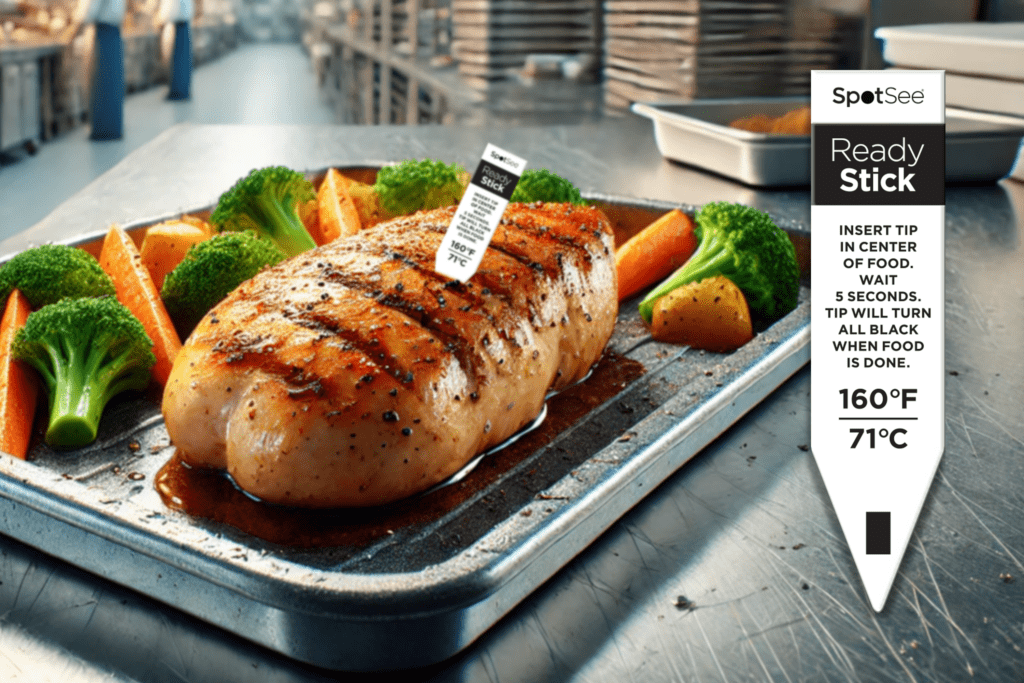
ReadyStick is a single-use temperature verification tool designed for exactly these decision moments.
It is a food safestick with a thermochromic tip that:
- Changes from white to black when the surrounding area reaches 160°F / 71°C
- Provides a visual confirmation in about five seconds
- Can be retained as proof that a minimum temperature requirement was met at a specific checkpoint
In practice, this makes it usable both in the kitchen and in-flight, where time and documentation constraints are highest.
Operational boundaries matter:
- Irreversibly indicates temperature at the tip at the moment of use
- Supports verification at point of use, including onboard reheat checks
- Does not replace calibrated probe thermometers or required HACCP documentation
The role is simple: confirm the threshold at the moment of decision, and create a piece of evidence that can travel with that decision.
Example airline catering workflow checkpoints
These are the points where documentation most often degrades, and where simple, retainable proof is most useful:
- Kitchen or in-flight reheat verification
Decision: confirm minimum temperature requirement has been reached before service - Before tray assembly or portioning
Decision: product is ready to move forward - Hot hold verification
Decision: continue holding, reheat, or remove from service - Handoff to service or flight crew
Decision: food is cleared for service - In-flight service check
Decision: confirm reheated meal meets minimum temperature before serving to passengers
At each of these points, ReadyStick can be used to create a visible, immediate confirmation tied to that specific moment.
Making retainable evidence work in practice
For documentation to hold under pressure, it must follow the same path as the food and the decision.
If single-use indicators are used as part of your SOP:
- Define where they are retained: cart documentation, kitchen records, or flight records
- Label them with context such as date, service stage, or route
- Align retention with internal SOPs and customer requirements
The goal is not more paperwork. It is a simple, physical proof that stays attached to the decision it represents.
Integrating into existing SOPs
Implementation works best when it supports existing decisions rather than adding new ones.
A practical approach:
- Identify checkpoints where minimum temperature must be confirmed
- Use ReadyStick as a verification step at those points
- Maintain probe thermometer use where numeric recording is required
- Train teams on clear actions tied to results: proceed, reheat, or remove
This keeps the workflow aligned with food safety requirements while improving documentation consistency.
Addressing common concerns
- Is this a replacement for thermometers
No. ReadyStick supports threshold verification at point of use. Calibrated probe thermometers remain required for numeric measurement and validation - Does it add extra work
Not if it replaces informal steps like delayed logging or repeated checks. It shifts documentation to the moment of action rather than adding a separate task - Is it reliable for audits
What matters is consistency. When used within an SOP with defined retention, it provides a clear, traceable record of the decision moment
Simple implementation checklist
- Identify where documentation breaks under peak service conditions
- Include both kitchen and in-flight checkpoints
- Add a verification step tied to those decision moments
- Define retention and labeling rules
- Train teams on decision criteria and corrective actions
Conclusion
Food safety checks rarely break because teams skip them. They break because documentation does not keep up with the pace of service.
When proof is created at the same moment as the decision, it becomes easier to retain, review, and trust.
In airline catering and onboard service, that shift, from recording later to verifying and retaining immediately, is what turns a completed check into usable evidence.
—
You might also like:


