

Last mile is where cold chain compliance becomes personal. A clinic, lab, pharmacy counter, or patient opens the box and has to decide what happens next. Visual indicators are effective at showing a clear good read or bad read at receipt, enabling fast disposition decisions. The operational gap is that many receiving teams cannot easily prove the check occurred for a specific unit, at a specific hand-off, or at the exact moment of customer receipt. For years, this has been the natural limit of visual-only indicators: rapid decisions in the moment, but limited proof after the fact.
Scan-on-receipt closes that gap by turning a visual check into a retrievable digital record without changing the role of validated packaging. This reflects an evolution in how SpotSee applies QR, shifting indicators from a static label to an operational workflow tool that supports both immediate action and defensible documentation.
The proof gap at customer receipt
In cold chain receiving, the decision moment is fast. A receiving tech checks the indicator, follows the SOP, and either accepts, quarantines, or escalates based on the organization’s process. In last mile delivery, that “receiver” might be a lab accessioning team, a pharmacist, a clinic nurse, or an end customer who simply wants to know, “Is this still okay to use?”
Later, the questions tend to be different. Quality teams and operations teams may need to answer, “Was the indicator checked at receipt?” and “Is there evidence tied to this unit?” Visual-only checks can be real and consistent, but the evidence trail is often fragmented across photos, emails, and notes that are not reliably tied to a device serial number and a scan event. And customer recipients may not check or understand indicators at the time off receipt.
This is why QR-enabled workflows matter. The goal is hand-off documentation and workflow evidence. QR, used well, preserves proof of the receiving moment without changing what the indicator is designed to do.

Why visual-only indicators are no longer enough on their own
A visual indicator supports an immediate decision. It does not, by itself, create a searchable record of who checked it, when it was checked, and which specific unit was checked.
When a temperature-excursion dispute or investigation arises after delivery, teams often have to piece together what happened at receipt from scattered evidence: emails, informal notes, and photos that are not consistently tied to a device serial number or a documented receiving event. That added forensic effort slows investigations and increases the likelihood that different sites document the same scenario in different ways. That reconstruction adds time and increases the chance of inconsistency between sites.
The operational shift is to make the receiving check a consistent event – regardless of recipient – that can be retrieved later, and tied to a unit identity.
This is the gap SpotSee addressed by adding QR directly into indicator workflows.
What scan-on-receipt adds
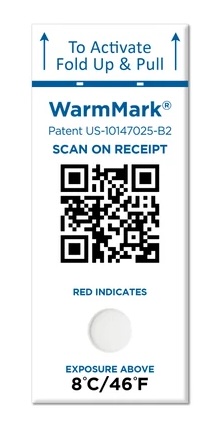
QR-enabled indicators such as WarmMark QR preserve the behavior receiving teams or customers already rely on. The indicator still delivers a clear visual good read or bad read at the moment of receipt.
What changes is the evidence. A scan at receipt creates a digital record tied to that specific unit, capturing status of the indicator when the check occurred, where it occurred, a photo, and which serial was scanned.
In this model, QR does not replace visual indication. It extends it.
One important clarification for compliance and process design is that the scan captures an event record (the fact that a check occurred and what was observed at that moment). The action taken (accept, quarantine, investigate, reject) remains governed by the receiving SOP and, where applicable, recorded in the organization’s receiving or quality workflows. This is true whether the “receiver” is an internal team or an external customer recipient.
Callout:
The shift is not more temperature data
The shift is a documented receiving check that is easier to retrieve and review
How this fits with validated packaging
Scan-on-receipt should be treated as workflow evidence, not as a replacement for established qualification and monitoring approaches.
A practical way to separate responsibilities is:
- The indicator provides operational visibility based on ambient exposure at the indicator location. It does not confirm internal product temperature.
- The QR scan creates a digital record of the receiving event, including when/where the indicator was scanned and which serial was scanned.
- Validated packaging remains required for shipping performance. It is the foundation for maintaining the intended environment through distribution. QR does not change that requirement.
Why QR is showing up in customer-facing receiving now
QR has moved beyond marketing. In operations, it’s increasingly an interface between a physical item and a digital record.
Standards like GS1 Digital Link reflect a broader industry direction: using 2D codes to connect physical products to digital information in a structured way. The practical implication for last mile is simple: scanning can become the lowest-friction way to create a unit-level event record at the exact point where ownership and responsibility shift.
What this means for labs, clinics, and end customers
Last mile recipients don’t want another system. They want clarity and a simple next step. A QR-enabled workflow supports that reality:
- It prompts a consistent action at receipt (scan to check).
- It reduces “interpretation drift” across locations (everyone performs the same step).
- It creates evidence that can be referenced later without asking the recipient to “prove” what they saw.
Where WarmMark QR and SpotSee Cloud fit
WarmMark QR is a single-use, battery-free temperature indicator that combines visual status with QR-enabled scan records. Those scan records can be sent to the SpotSee Cloud for visibility and retrieval.
In practical terms, the SpotSee Cloud supports common operational needs: viewing recent scans, reviewing shipment/unit details, and maintaining an audit-oriented history of scan events so teams can retrieve evidence without chasing emails and photos.
Integration option for workflow systems: SpotSee WarmMark QR API
For organizations that want scan events to appear in internal systems, SpotSee provides an open API platform for account-specific scan data, and current platform integration options. pulling scan history, and using a shipment ID field to map scan events to existing shipment records.
A concrete outcome: fewer returns in a mail-order pharmacy program
SpotSee’s mail-order pharmacy case study reports a change in returns after implementing WarmMark QR:
- Before: average 15 returns per week
- After: 15 returns per quarter
The case study outlines a sample financial model to illustrate potential impact. Using an estimated $250 cost per return for modeling purposes, the scenario shows how return-related costs could reach approximately $45,000 per quarter, or $180,000 annually. These figures are specific to the example presented and are intended to demonstrate how return costs can accumulate, rather than represent a universal benchmark.
Put simply: if return volume shifts from the case-study “before” level of 15 returns per week to the “after” level of 15 returns per quarter, then under the assumed $250-per-return model, annual return-related costs could decrease by up to approximately $180,000.
The exact financial impact will vary by organization, but the example highlights how reducing avoidable returns can materially change the cost profile of a distribution program.
Conclusion
Visual indicators provide fast, actionable status at receipt. Scan-on-receipt makes that status easier to prove later, because the receiving check becomes a retrievable, unit-linked record that supports consistent SOP execution or customer reaction across last-mile hand-offs.
The operational win is not replacing validated packaging, it is making the receiving check defensible.
—
You might also like:


