

When blood bags return from the OR, cold storage staff need a decision they can defend: protect patient safety, conserve a scarce resource, and avoid preventable waste.
A surgery team orders eight units of O-negative blood for an emergency trauma case. The team uses three. The remaining five bags sit on a surgical cart for 45 minutes before they are returned to the hospital blood bank. Cold storage staff face a decision: Accept these bags back into inventory for the next patient, or discard them as potentially compromised? Without a reliable temperature record from the operating room to cold storage and back, that decision becomes guesswork, exactly where you don’t want to be when safety and supply are on the line.
In this article, we’ll reference “$250 per unit” as a practical, all-in operational estimate of what it can cost a facility to make a single blood unit available for transfusion: collection, processing, testing, labeling, storage, handling, and internal distribution, not the “value” of the blood itself.
The return-to-cold-storage decision point in hospital blood banks
In most hospitals, blood leaves controlled cold storage because clinical demand is immediate and unpredictable, especially in the OR, ED, and trauma settings. Once a unit is issued, the clinical team’s priority is (appropriately) the patient, not the clock. That’s why unused units can end up sitting on a cart, in a procedure room, or in transit longer than intended.
When those units come back, blood bank and pathology lab staff are put in a tight spot: you need to be conservative enough to protect patient safety, but practical enough to avoid discarding a precious resource based on uncertainty. If all you have is a time estimate or conflicting recollections of “how long it was out”, accept/reject decisions become inconsistent across staff and shifts.
HemoTemp II is designed for that exact internal hospital journey: it provides clear, visual temperature indication tied to the blood bag’s core-correlated temperature, so the return handoff isn’t a debate.
How the reversible and irreversible windows work together
Hospital blood bank managers and pathology lab supervisors often ask whether one temperature window is sufficient for accept/reject decisions. In practice, surgical staff and cold storage staff need different information at different decision moments.
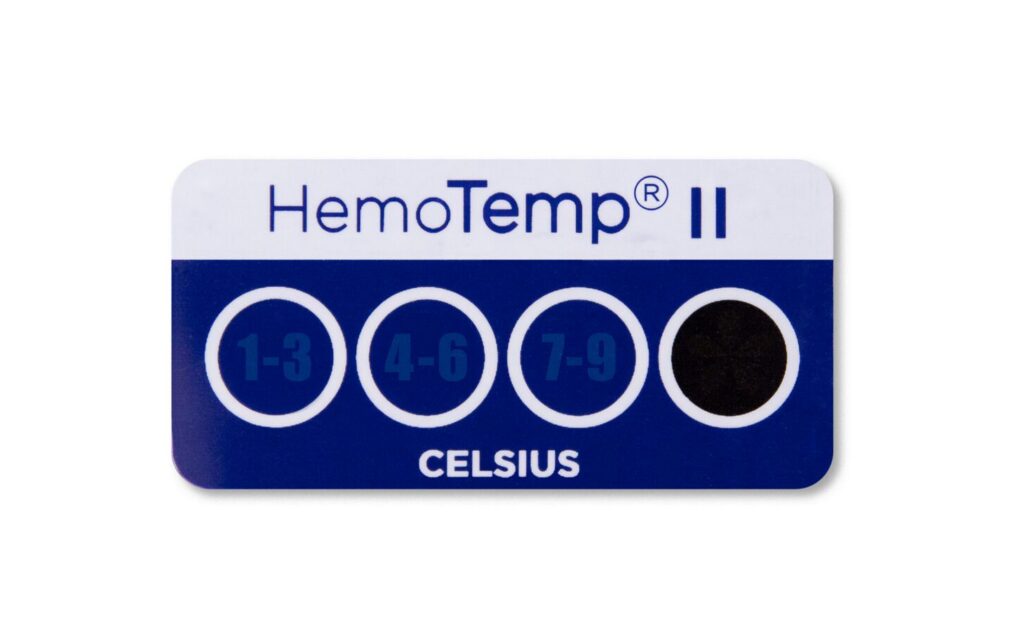
The HemoTemp II uses a four-window system designed for these distinct needs.
Three reversible windows display the current core-correlated temperature of the blood bag in real time. Windows change color as the blood warms or cools, always showing the present state. Surgery staff monitor these windows to identify when blood is warming too quickly, a signal that the bag needs to return to cold storage.
The fourth window (flower/irreversible) turns tan or brown once blood exceeds 10°C. This irreversible window provides a permanent record. Even if the blood bag cools again, the flower shows it crossed the 10°C threshold. Cold storage staff use the flower window to determine if returned blood is safe to accept back into inventory.
This dual-function design gives surgical teams current-state awareness during procedures and cold storage teams historical confirmation at return handoff.
What HemoTemp II indicators actually do
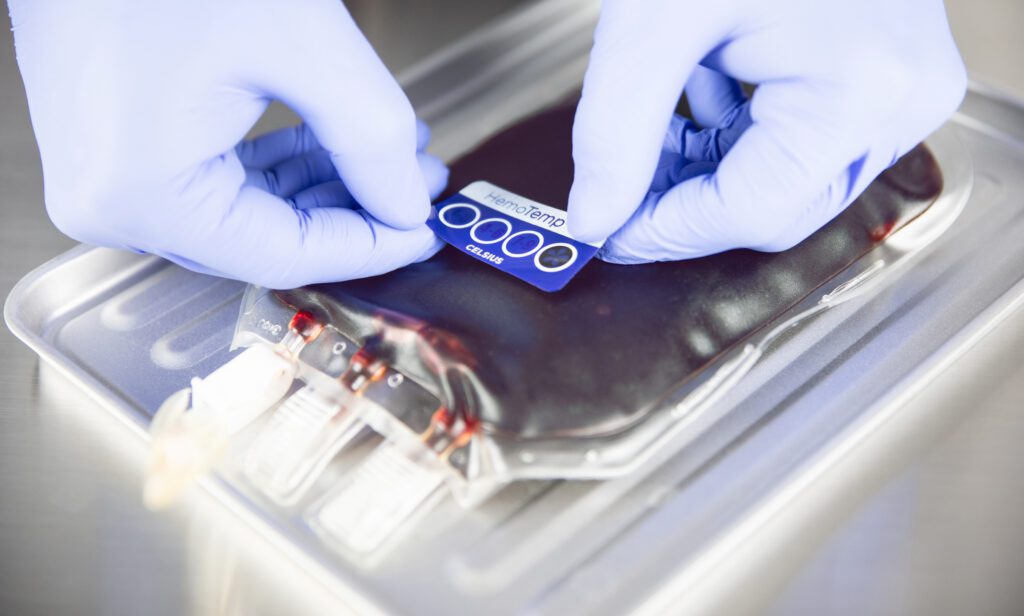
The indicator adheres directly to the blood bag surface. The flexible design conforms to bag movement and storage. Before application, cold storage staff precondition the indicator by heating it to 44°C for 60 seconds. This preconditioning step activates the chemicals in the irreversible window. The flower window turns blue when active. If the flower is clear, the indicator was not properly activated.
High adhesion and minimal profile reduce the risk of detachment during handling in surgical and transport environments. The core-correlated temperature measurement reads the blood bag’s internal temperature, not ambient air temperature. This distinction matters. A blood bag sitting in a cool OR may still have a core temperature above safe thresholds if it was recently removed from cold storage.
The indicator provides continuous temperature visibility from cold storage to surgery suite and back.
Which hospital environments see operational benefits
HemoTemp II is most operationally valuable anywhere blood routinely moves between controlled storage and high-urgency clinical areas: high-volume ORs, emergency and trauma settings, and surgical suites that order surplus units due to uncertainty in blood loss.
The benefit isn’t just “saving money.” It’s helping facilities conserve scarce inventory (especially rare blood types) by avoiding unnecessary discards when units truly stayed within threshold, while still supporting conservative discard decisions when an excursion did occur.
How HemoTemp II fits into internal hospital blood workflows
HemoTemp II integrates cleanly into the handoff between cold storage and clinical teams. Blood bank staff precondition and apply the indicator before dispatch, giving surgical teams a real-time view of temperature status through the reversible windows during use.
When unused units are returned, cold storage staff rely on the irreversible flower to make a clear accept-or-discard decision. A blue flower supports return to inventory, a tan or brown flower confirms an excursion and supports discard per protocol, and a clear flower indicates the indicator was not properly activated.
The advantage is a shared, visual decision point at return, with no downloads or interpretation delays. If required, photography can support documentation within existing hospital protocols.
Why the 10°C threshold and irreversible window matter
Blood becomes unusable once the temperature exceeds 10°C due to bacterial growth risk and product degradation. Even if blood is recooled after warming above 10°C, it cannot safely re-enter inventory.
Reversible windows alone cannot confirm whether blood temperature rose above 10°C earlier and then cooled again. The irreversible flower window provides permanent confirmation. If tan/brown, the blood exceeded 10°C at some point. With this information, cold storage staff can confidently disregard returned blood showing an activated flower, regardless of current temperature.
This supports compliance with temperature control requirements. Specific regulatory standards vary by jurisdiction, but the 10°C bacterial and degradation threshold is consistent across blood safety protocols.
Use case: Maximizing rare blood inventory in emergency surgery
Consider a hypothetical emergency surgery requiring multiple units of AB-negative blood, a rare type. Because the situation is urgent and blood volume needs are uncertain, the team orders surplus units. The case ends with five unused bags, then clinical priorities take over, and the return to cold storage is delayed by 40 minutes.
Without HemoTemp II: cold storage staff are left piecing together a timeline. When the safest choice is unclear, teams may discard the units to eliminate doubt. That protects patients but it can also remove scarce, hard-to-replace inventory from circulation unnecessarily. Using the “$250 per unit” operational cost representation, five discarded units reflect not just $1,250 in avoidable spend, but also lost availability of a precious resource.
With HemoTemp II: the decision becomes visual and defensible. Surgical staff can see warming in the reversible windows during staging, and on return, cold storage staff can rely on the irreversible flower: blue supports return-to-inventory; tan/brown confirms an excursion and supports discard per protocol.
At approximately $2 per indicator, the cost consideration is straightforward. A $2 device supports informed decisions that can save a $250 blood bag, as well as confirm the safety of the blood for future patients.
A brief counterargument: Why not just use time estimates?
Some blood bank managers argue that well-trained staff can estimate safe temperature exposure based on time out of refrigeration. This approach works until it doesn’t. Time estimates don’t account for variable ambient temperatures in different surgical suites, delays in return transport, or blood bags left on carts in hallways. Temperature indicators add objective data at the decision point where estimates fail.
The HemoTemp II complements existing protocols by adding visual confirmation at handoff points.
Procurement and implementation factors
Hospital administration and procurement professionals evaluate the cost consideration. A $2 indicator can prevent the inappropriate discard of a $250 blood bag and reduce waste of blood inventory.
Blood bank managers and quality assurance staff focus on validated performance. Core-correlated measurement, preconditioned application, and validated performance for blood bag use.
Surgical staff need real-time awareness. Reversible windows show when blood needs to return to cold storage.
Cold storage technicians need historical confirmation. The irreversible flower window confirms safe return-to-inventory or required discard.
Single application per blood bag supports internal hospital transport from cold storage to surgery and back.
Next step
Review HemoTemp II technical specifications and hospital blood bank application guidance at spotsee.io. Contact SpotSee to discuss integration with your facility’s blood inventory management protocols.
—
You might also like:


