

Most freeze damage is invisible until the product fails, and by then, it’s too late to trace the root cause or file a claim.
Chemical manufacturers and paint distributors often discover freeze damage weeks after shipment, when emulsions have separated, polymers have destabilized, and customers are demanding replacements. At that point, proving a carrier was at fault becomes nearly impossible. ColdMark freeze indicators address this visibility gap by providing irreversible proof at the moment of handoff, giving you a clear operational decision: accept or reject.
The visibility gap in chemical and paint transit
Chemical manufacturers ship temperature-sensitive formulations year-round. Winter transport exposes products to freezing conditions in truck trailers, railcars, and distribution centers. Freezing can compromise product integrity, but carriers rarely document temperature conditions. Without evidence, claims get disputed. Without real-time visibility, damaged goods enter the supply chain.
Paint and coatings distributors face a related challenge. Latex paints and water-based stains freeze below 0°C. Once frozen, they separate, which can result in poor adhesion, uneven finish, and premature cracking or peeling upon application. Visual inspection at receiving doesn’t always catch freeze damage. Accepting a compromised shipment risks customer complaints and returns. Rejecting a good shipment delays projects and frustrates suppliers.
Supply chain logistics for industrial chemicals requires more than insulated packaging. You need operational clarity at critical handoff points such as carrier pickup, warehouse receipt, and customer delivery. Data loggers capture history but require download and analysis. Most monitoring tools provide data after the fact. ColdMark indicators provide decisions in real time.

How ColdMark freeze indicators work
ColdMark is a visual freeze indicator applied to packages or pallets. Inside, a phase-change material remains stable above a set threshold. When ambient temperature drops to or below that threshold for a sufficient period, the material activates and changes appearance permanently.
We’ve worked with supply chain professionals across life sciences, pharmaceuticals, and industrial chemicals for over two decades. ColdMark indicators meet regulatory expectations for visible monitoring in temperature-sensitive supply chains, providing the operational clarity that receiving teams need when shipments arrive.
Key characteristics:
- Activation is irreversible: Once triggered, ColdMark cannot reset, even if temperature rises.
- Binary read: The indicator either activated (bad read) or did not (good read).
- No power required: ColdMark works passively throughout transit, with no batteries, calibration, or software.
Designed for simple, reliable decision making
ColdMark is designed to provide a clear, visual pass/fail indication rather than detailed temperature data. It does not measure exact temperature values or exposure duration, and it is not intended to replace validated packaging, data loggers, or stability testing. ColdMark monitors ambient temperature near the package rather than internal product temperature, so placement and package design are important.
Operational role: ColdMark gives receiving staff and logistics coordinators a visual checkpoint. It answers one question clearly: Did this shipment experience a temperature excursion below freezing?
One common misconception is that ColdMark reacts to brief temperature drops. In reality, activation time is within 30 minutes, designed to prevent false positives from momentary cold snaps. Another misconception: that freeze indicators replace data loggers. They don’t. ColdMark provides instant operational decisions; loggers provide compliance documentation and root-cause investigation. Both tools serve distinct purposes in a layered monitoring strategy.
Selection and application guidance for ColdMark
Step 1: Identify your product’s freeze threshold
Check product stability data, formulation specs, or supplier guidance. Common thresholds:
- Water-based paints: 0°C
- Emulsion polymers: -2°C to 0°C
- Industrial adhesives: Varies by formulation
Step 2: Select the right ColdMark threshold
ColdMark indicators are available in multiple threshold options. Choose an indicator that activates at or slightly above your product’s freeze point. This creates an operational safety margin and clear decision criteria. Ambient air temperature does not always match product temperature. Container mass, insulation, and exposure time all influence actual risk.
Step 3: Determine application points
- Inner cartons: For individual product verification
- Outer cases: For batch-level monitoring
- Pallet wrap: For full-pallet visibility during distribution
Place ColdMark indicators near the product, not isolated in airspace. Indicators respond to ambient temperature, so proximity improves operational relevance.
Step 4: Train receiving staff
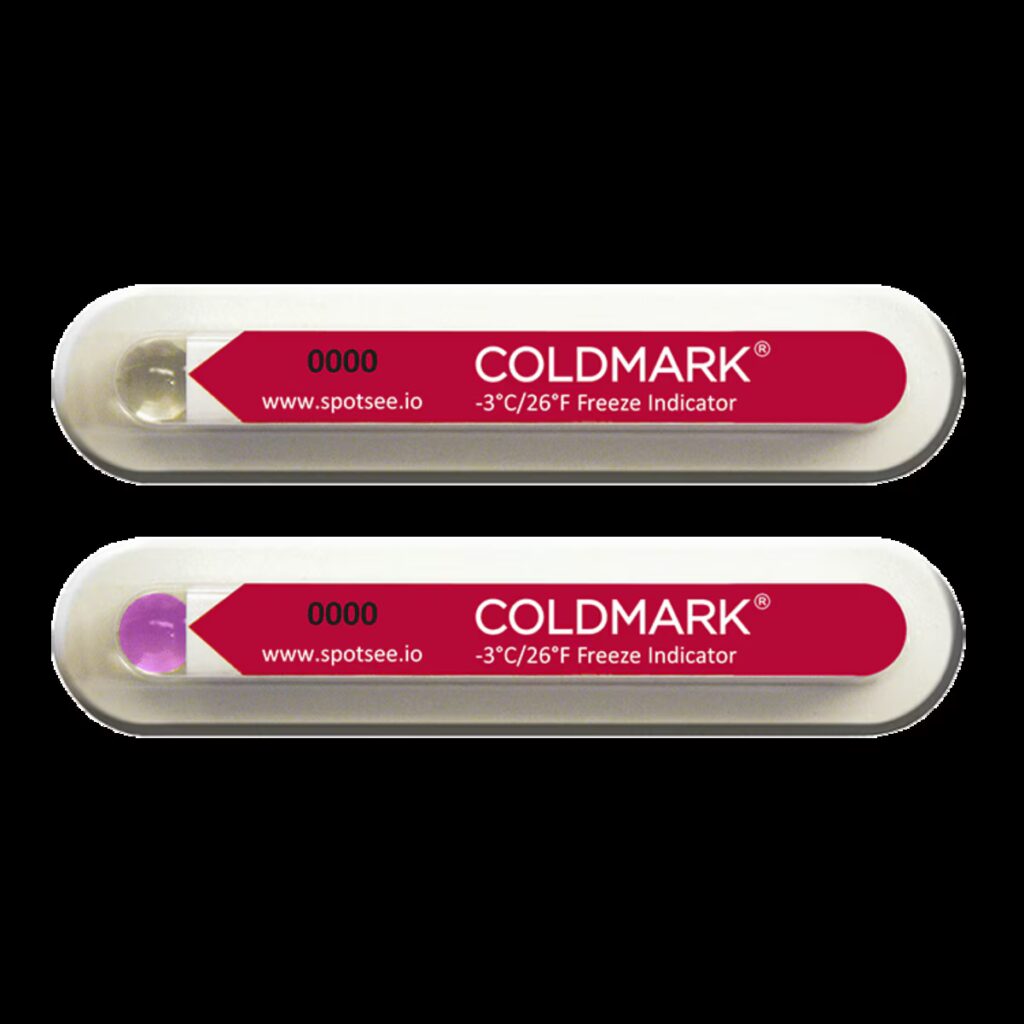
Provide clear visual references showing activated versus non-activated ColdMark states. Include a decision tree:
- Good read (indicator window is clear) → Accept shipment, proceed with normal handling
- Bad read (indicator window is violet) → Quarantine, notify QA, document findings, initiate claim or rejection process
Step 5: Document and escalate
Record ColdMark status on receiving documents or bills of lading. Photograph activated indicators for claims and root-cause investigation. Integrate findings with data logger reports if available.
Step 6: Review and adjust
Track activation rates by carrier, route, and season. Use findings to adjust packaging, routing, or carrier selection. ColdMark provides operational data that supports continuous improvement.
Use case: Industrial coatings distribution in winter transport
A coatings manufacturer ships water-based industrial stains to distributors across the northern U.S. during winter. These products freeze below 0°C, which causes permanent separation and makes the shipment unusable. Every January and February, returns and claims rise as colder weather increases exposure risk.
To address this risk, a manufacturer could apply ColdMark freeze indicators (0°C threshold) to each pallet before shipment. Upon receipt, distributors would check the ColdMark indicator as part of their standard intake process. A good read would signal that the shipment can move forward as expected, while a bad read would prompt the team to quarantine the pallet and notify the supplier for follow-up.
Over time, this approach can lead to measurable improvements. Claims processing may become faster because objective evidence is available at the moment of receipt. Carriers may begin adjusting handling practices as activation patterns highlight where and when freeze exposure occurs. Distributors can also avoid unnecessary rejections, since a good read provides confidence that the product has not been compromised. The expected result is reduced product loss from freeze damage and fewer disputes across the supply chain.
Key takeaway: ColdMark does not eliminate freeze risk. It makes the risk visible at the right time, giving teams the clarity they need to make informed, confident decisions.
Layered monitoring: Combining ColdMark with other tools for complete visibility
Validated packaging protects products during transit. Insulated containers, gel packs, and temperature-controlled shipping reduce the likelihood of temperature excursions. Validation confirms packaging maintains target temperature range under defined conditions. The limitation: validation doesn’t confirm performance in every shipment or under unexpected conditions like extended delays or extreme weather.
Data loggers record temperature continuously throughout transit, providing a detailed history for compliance, root-cause investigation, and carrier claims. The limitation: they require download and review, which doesn’t support immediate decisions at the receiving dock.
ColdMark freeze indicators provide instant, irreversible confirmation of freezing events at handoff points. They enable operational decision-making at receiving docks, warehouse transfers, and customer delivery. They don’t replace continuous monitoring or detailed temperature records. ColdMark monitors ambient conditions near the package, not validated internal product temperature.
Integrated approach: Use validated packaging to protect product. Apply data loggers for compliance and investigation. Add ColdMark for real-time operational visibility. Each layer addresses a different need. Together, they create a layered supply chain system.
Integrated approach use case: pairing ColdMark with loggers and validated packaging
A chemical supplier ships temperature-sensitive chemicals in validated insulated boxes (protection), with data loggers inside (compliance), and ColdMark indicators on the inside of the packaging, but easily visible (operational check). Receiving staff inspect ColdMark first. If it shows a good read, they proceed with normal handling. If it shows a bad read, they escalate to QA, who reviews logger data to determine the extent and duration of exposure. The result: fast decisions at receiving, detailed evidence for claims or rejections, and continuous improvement through combined data.
Addressing a practical reality: when validated packaging isn’t feasible
In many industrial chemical and coatings supply chains, validated packaging is not always practical. High shipment volumes, palletized loads, large containers, and cost constraints often mean products move through temperature-controlled environments rather than fully validated shipping systems.
For paints, coatings, and bulk chemicals, shipments may rely on ambient trailers, insulated pallet wraps, or warehouse temperature management rather than individual validated packaging configurations. In these scenarios, receiving teams still need a clear, shipment-level confirmation that freezing did not occur.
ColdMark integrates directly into the receiving checklist for these operations. Applied at the pallet or case level, it provides an immediate visual confirmation at receipt without slowing down intake workflows. This allows teams to quickly accept, quarantine, or escalate shipments based on objective evidence, even when validated packaging and internal loggers are not part of the shipping configuration.
In these environments, ColdMark is not a backup to validation. It becomes a practical control point that supports consistent decision-making across high-volume, palletized supply chains.
Operational benefits across the supply chain
For chemical manufacturers:
- Reduce claims disputes with objective ColdMark evidence
- Improve carrier accountability through documented performance
- Protect brand reputation by preventing damaged goods from reaching customers
For paint and coatings distributors:
- Accelerate receiving inspections with clear pass/fail criteria
- Reduce product loss by catching freeze damage at the entry point
- Improve supplier relationships through transparent monitoring
For logistics providers:
- Faster receiving decisions with less guesswork
- Clear escalation path when ColdMark activates
- Documentation that supports carrier liability discussions
System-level benefits:
- Faster root-cause analysis when ColdMark is combined with data logger records
- Continuous improvement through activation trend analysis
- Alignment with supply chain best practices and regulatory expectations
Conclusion
ColdMark freeze indicators provide operational visibility at the moments that matter: receiving docks, warehouse transfers, and delivery. They give you objective evidence to make accept/reject decisions, support claims documentation, and prevent damaged products from entering/leaving your supply chain.
Your next step: Review the technical information and threshold options for ColdMark freeze indicators on the product page. Identify the right activation point for your products, and request samples to test integration with your current receiving Standard Operating Procedure (SOP).
—
You may also like:
- Expanding cold chain visibility: Tracking freeze excursions with FreezeSafe, from cold chains to direct-to-patient
- Complete cold chain confidence: Monitoring high and low extremes with a single indicator
- Precision matters: Selecting the right temperature range for pharmaceutical indicators


