

Not every workflow needs a data logger
Every temperature monitoring decision starts somewhere. And for many teams, it starts with the same assumption: more data is better. So they reach for connected loggers, cellular devices, and cloud dashboards, even when the question they actually need answered is much simpler.
Did the dishwasher hit sanitizing temperature? Did this component see heat it shouldn’t have? Did the food reach 160°F before it left the kitchen? Those are pass/fail questions. They don’t need a data trail. They need a fast, reliable answer.
SpotSee’s range of temperature indicators is built exactly for those moments. Before reaching for a data logger, it’s worth asking which question you’re actually trying to answer.
The real question behind most temperature checks
Most temperature monitoring needs fall into one of two categories. The first is pass/fail: did this reach the right temperature, or didn’t it? The second is historical: what happened over time, across a journey or process?
The second category is where data loggers earn their place. But the first category, which covers a large share of real-world compliance moments, doesn’t require a timestamped record. It requires a confirmed event. A color change that says yes or no. That’s what a temperature indicator does, and it does it without batteries, connectivity, or a download.
The right tool depends on the question. Starting there keeps workflows lean and evidence clear.
Where pass/fail indicators do the job
Three application areas consistently call for a simple indicator over a full monitoring system.
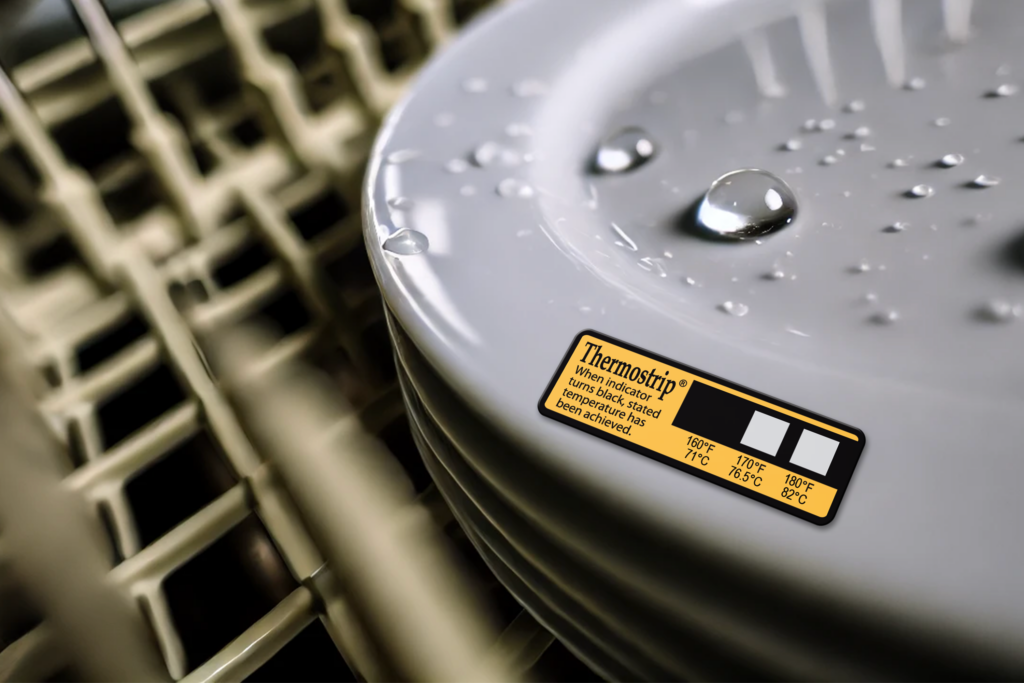
Food service sanitation. Commercial kitchens operate under HACCP requirements that include verifying sanitizing temperatures in dishwashing cycles. ThermoStrip DL and ThermoStrip DS are single-use indicators designed for exactly this. ThermoStrip DL confirms dishwasher water and surface temperatures in the 160-180°F (71-82°C) range. ThermoStrip DS verifies sanitizing temperatures at 160°F or 180°F thresholds, with slotted tabs for attaching to utensils or trays. Both change color irreversibly when the threshold is reached, include space to date and initial, and serve as a permanent batch record. No setup. No download. The record is built into the strip.
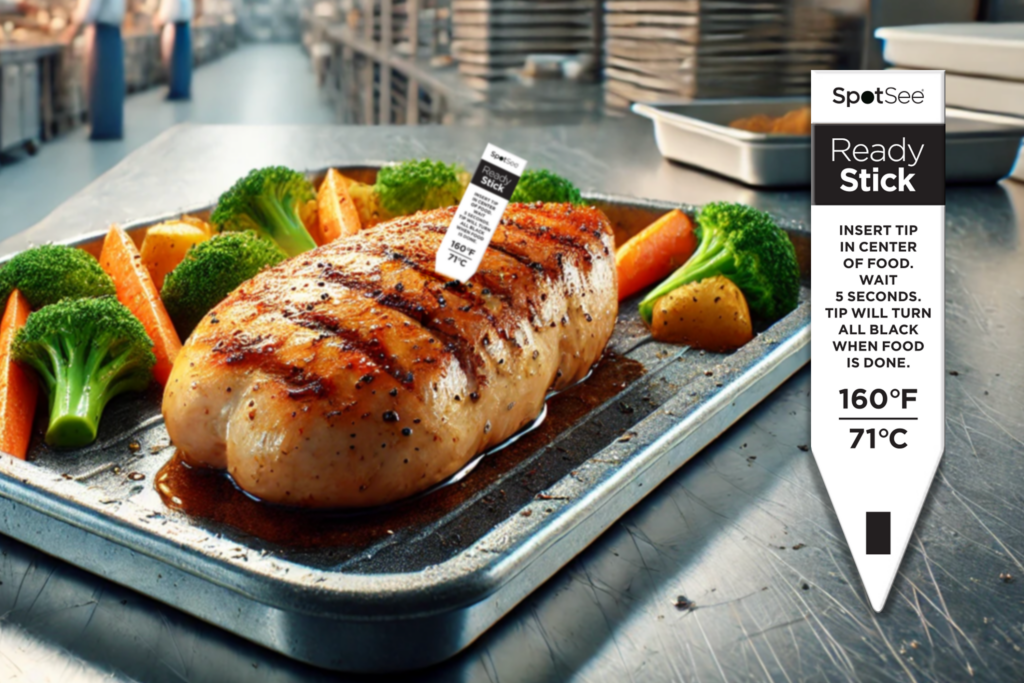
Food temperature at service. ReadyStick takes a different approach to the same question. It’s a disposable thermometer stick with a color-changing tip that turns from white to black when the internal food temperature reaches 160°F. Insert it, wait about five seconds, and you have a verifiable answer. It can also be used to confirm utensil sterilization in dishwashers, and each stick functions as a permanent record of the temperature event.
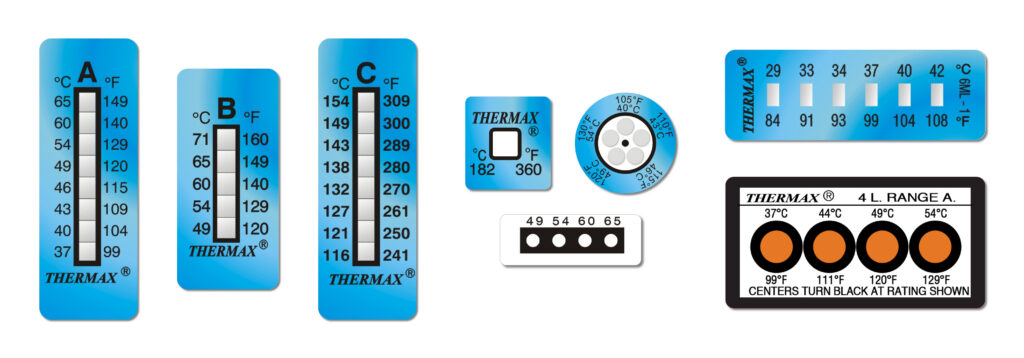
Industrial process and field verification. Thermax irreversible temperature recording indicators are self-adhesive, multi-element labels that permanently record the highest temperature a surface or component has reached. Phase-change chemicals melt at calibrated thresholds and produce an irreversible color change, covering a range from 84°F to 554°F (29°C to 290°C). In process control, maintenance checks, and warranty documentation, the question is usually the same: did this see heat it shouldn’t have? Thermax answers it without requiring any equipment, connectivity, or retrieval workflow.
How to match the tool to the moment
The decision isn’t complicated once you start with the right question.
If your Standard Operating Procedure (SOP) requires evidence that a specific temperature was reached at a specific moment, a temperature indicator is the right call. It’s fast, it’s low cost, and the evidence is built into the product itself. No additional hardware, no software, no retrieval step.
If your SOP requires a timestamped record of conditions over time, across a shipment or a storage period, that’s a different requirement. Data loggers are built for that job. The two tools answer different questions, and neither replaces the other.
For most food service sanitation checks, lab sterilization cycles, and field process verification, the question is a pass/fail one. That’s where indicators work best: one question, one event, one answer.
Find the right indicator for your workflow
SpotSee’s temperature indicator range covers the most common pass/fail moments across food service, industrial, and lab environments. Browse the full range to match your application to the right tool.
Explore SpotSee temperature indicators: https://shop.spotsee.io/temperature_indicators
—-
You might also like


