

A package arrives at a transplant center. The surgical team is already in motion, the transplant window is narrow, and the implant, tissue, or organ is expected. The product looks correct. The packaging is intact. The team proceeds.
None of that confirms the product was never exposed to a damaging temperature excursion. It confirms only that no one captured evidence of one.
For donor organs, orthopedic implants, and surgical biologics, the final hand-off before use is one of the highest-risk moments in the cold chain. It is fast, it is high-pressure, and it is rarely built to catch an excursion that left no visible trace. A ColdSnap indicator applied at the point of packaging is built for exactly this moment. It gives the receiving team a permanent, visual answer the instant the product arrives, without slowing down the intake process.
Medical device and organ logistics involve more hand-offs than most teams realize
Donor organs, orthopedic implants, and surgical biologics rarely travel a direct path. A shipment can move from the manufacturer or organ procurement organization to a regional distributor or transport carrier, to facility storage, before it ever reaches the operating room or transplant suite. Each transition is a point where temperature conditions can shift.
Unlike pharmaceutical cold chains, medical device and organ logistics often move without a dedicated cold-chain specialist at every stop. Multiple hand-offs are not a sign that something has gone wrong. They are the normal structure of how these products move, which is why passive, field-ready visibility at the point of arrival matters more than a system that only works when someone remembers to check it.
A product can arrive within range and still have crossed a critical threshold
Temperature excursions do not always leave physical evidence. There is no condensation, no packaging deformation, no alarm triggered at receipt. A shipment can look and feel completely normal.
This is where ambient indication and internal product temperature part ways. A product briefly exposed to a damaging cold or heat event can recover to an acceptable ambient range well before it arrives, which makes the excursion invisible to a visual check. For products with a low tolerance for threshold crossings, even a brief exposure can matter. As a result, the only reliable record is an indicator that captures the event permanently, at the moment it happens, rather than one that simply reports current conditions.

Transplant center intake is fast, high-stakes, and not built for cold-chain investigation
At a transplant center, the receiving moment looks nothing like a typical warehouse intake. The surgical team is prepared, the timeline is fixed, and the priority is clinical readiness, not paperwork.
Organ and tissue viability windows are narrow. Any delay spent trying to determine whether a product was compromised works against the patient, not for them. Because of this, the signal that tells the receiving team whether to proceed or escalate has to be immediate and visual, and it has to require no interpretation, no login, and no waiting on a report from somewhere else in the chain. This is the decision moment indicators are built to support: a good read or bad read available in seconds.
Documentation gaps lead to quality decisions without evidence
Shipment documentation for medical devices, biologics, and donor organs commonly breaks down between organizations rather than within them. The manufacturer or organ procurement organization completes its quality checks at the point of origin. The distributor or transport provider may or may not carry that documentation forward. By the time a product reaches facility intake, the receiving team often has no visibility into what happened upstream.
This fragmentation means that when a question comes up later, sometimes weeks later, the chain of custody cannot be reconstructed with confidence. Regulatory and quality expectations increasingly focus on the ability to demonstrate control across the full distribution path, not only at the point of manufacture or procurement.
‘We think it was okay’ is not a quality decision
Assumption-based acceptance cannot be audited. It cannot be defended in a quality investigation, and it does nothing to improve the process for the next shipment.
If an adverse clinical outcome or a quality investigation follows, the absence of receipt-level evidence makes it impossible to rule a temperature event in or out as a contributing factor. This is rarely a matter of a careless receiving team. It is a gap in workflow design: the evidence was never built into the process at the moment it needed to exist.
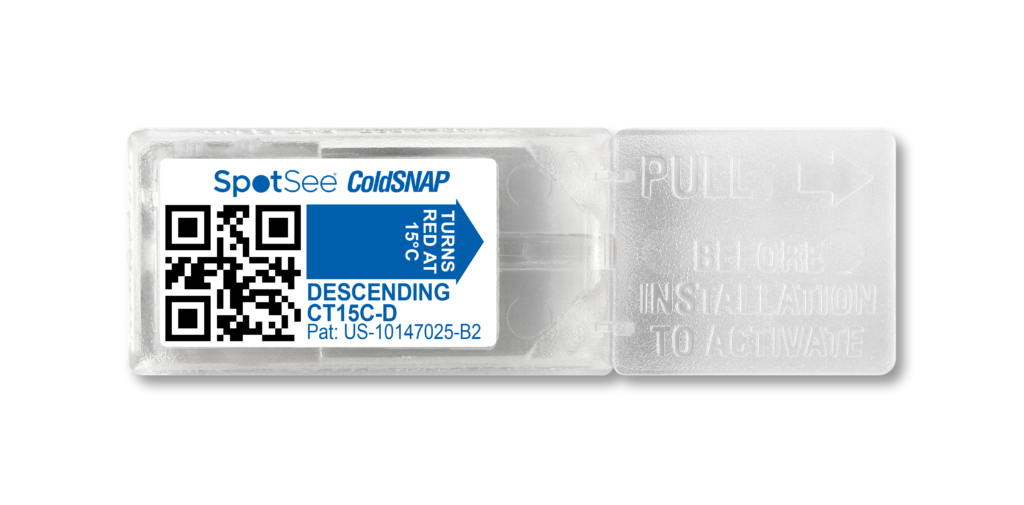
ColdSnap gives intake teams an immediate, irreversible answer
ColdSnap is a compact, self-adhesive temperature indicator built for high-value, temperature-sensitive shipments, including medical implants, surgical biologics, and donor organ transport. It requires no batteries and no electronics, and it does not need to be interpreted through a system at the moment of receipt.
The mechanism is simple. Once activated, the viewing window changes permanently from clear to bright red if the product crosses its rated temperature threshold, whether that threshold is an ascending or a descending limit. ColdSnap is available across threshold options from -20°C to +15°C and is calibrated to within 2°C, which allows it to be matched closely to a product’s specific temperature tolerance. ColdSnap+ models extend this further with dual-event monitoring, capturing both a critical cold event and a critical warm event on the same indicator.
For a transplant center or a device manufacturer’s receiving team, that means one glance answers the question a shipment record alone cannot: did this product cross a threshold it should not have. ColdSnap does not replace validated packaging or a data logger. It works alongside them, giving intake staff a fast, defensible basis for an accept, quarantine, or escalate decision under the facility’s existing SOP.
Close
For quality and clinical operations teams reviewing intake workflows, start with the hand-off moment itself. Ask what information the person accepting the shipment actually has, and what decision they are expected to make with it. If the honest answer is “none” and “proceed unless something looks wrong,” that is the exact gap a ColdSnap indicator is built to close.
—-
You might also like


