

Not every automotive part needs the same level of monitoring. A high-volume bracket moving between two nearby plants and a precision battery pack crossing three continents face different risks, and the right monitoring tool depends on the part’s value, the complexity of its journey, and what your team needs to do when damage occurs.
Damage rarely announces itself in transit. It shows up later, on the line, when a part fails inspection, and by then the shipment event that caused it is long over. This article walks through three levels of impact monitoring, from simple visual indicators to real-time cellular alerts, and shows how to match each one to the part and the decision it needs to support.
Why automotive shipments need different levels of monitoring
Automotive manufacturers ship enormous volumes of parts through complex, multi-leg supply chains involving multiple carriers and handling points. Component racks and packaging are routinely tested for impact and vibration resistance under lab conditions, yet parts still arrive damaged. That gap between controlled testing and real-world handling is where most supply chain damage originates.
One international automotive company experienced this directly, as documented in our Automotive Instrument Panels and Bumpers case study. Shipping more than 30 million car parts in 7,000 containers daily, the company found that instrument panels, a particularly sensitive component, kept falling off their transport racks during shipment between plants, even though the racks had passed standard impact and vibration testing. Without shipment visibility, the company had no way to isolate whether a specific carrier, handling point, or leg of the journey was responsible. Root cause and accountability are difficult to establish when the only evidence is the damaged part itself, discovered well after the event that caused it.
This is where a monitoring spectrum becomes useful. Not every part carries the same risk, and not every shipment needs the same response time. Matching the level of monitoring to the part’s value, its journey, and what the team needs to do next is the practical starting point for reducing automotive supply chain damage.
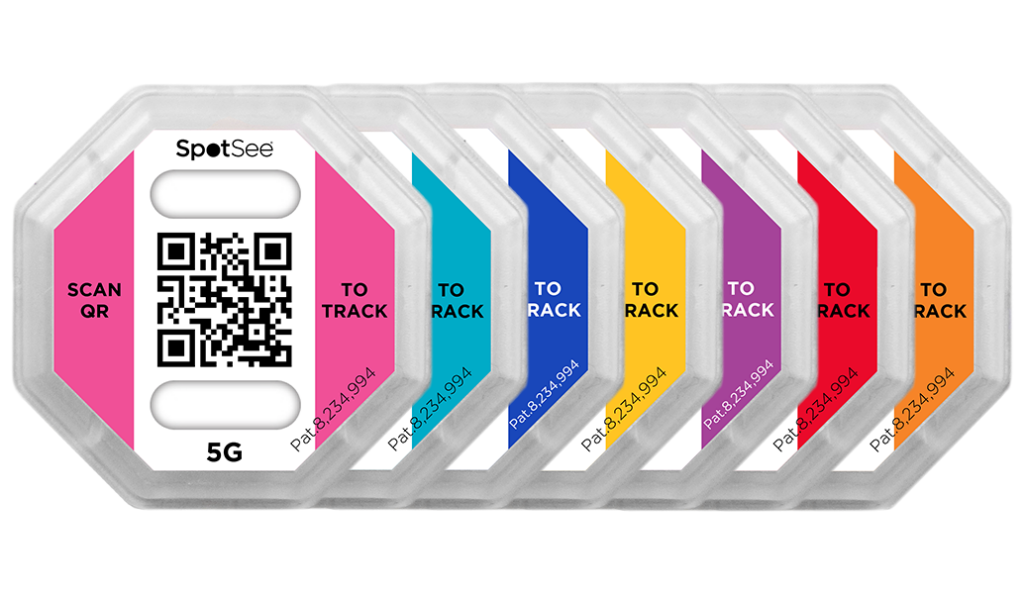
ShockWatch 2 QR: simple visibility at receiving
ShockWatch 2 QR is a visual impact indicator that activates irreversibly once a set threshold is crossed, making mishandling visible at a glance. Its QR code links directly to a damage report, so scanning it at receiving creates a documented record without manual data entry.
ShockWatch 2 QR fits high-volume parts and shorter supply chain legs, where the receiving team mainly needs a fast accept or inspect decision. The visible presence of the indicator on packaging also changes handling behavior: handlers who know a shipment is being watched tend to handle it more carefully, a deterrence effect a purely internal system does not provide.
The tradeoff is scope. ShockWatch 2 QR confirms an impact occurred and whether it crossed the threshold, but not when, where, or how many times. For parts where a single damage event needs to be traced back to a specific carrier or handoff, a monitoring solution with a stronger evidence trail is the better fit.
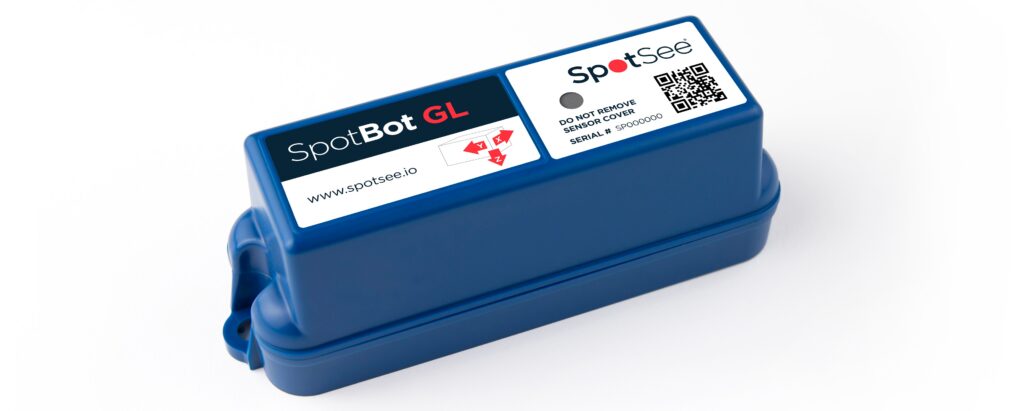
SpotBot GL: when environmental context matters
SpotBot GL is a real-time connected monitor. It tracks impact, temperature, and humidity simultaneously, with status and alerts visible throughout the journey rather than only after the shipment is received. Each parameter’s threshold is individually configurable, and any violation is time- and date-stamped, making it traceable to a specific point in the journey.
This makes SpotBot GL a strong fit for sensitive parts moving through multi-leg shipments, where a single impact reading does not tell the whole story. Batteries in particular are affected by temperature swings and humidity as well as physical shock, so a tool that only tracks impact would miss part of the risk picture.
A battery supplier for Formula E racing put this to the test, as detailed in our Formula E Batteries case study. Batteries are removed after each race, crated, and shipped to the next venue, sometimes with only a week between races across 11 cities on five continents. The supplier tested six ShockLog Cellular GL monitors and one SpotBot GL as part of a real-world evaluation.
Both ShockLog Cellular GL and SpotBot GL are real-time connected devices, so the choice between them is not about immediacy. It comes down to price and data depth. At roughly one quarter the price of ShockLog Cellular GL, SpotBot GL collects fewer data points and less granular detail. That makes it the practical choice when a part does not need that level of sensitivity, while the added cost of ShockLog Cellular GL is justified when the detail matters, whether that is for engineering root cause analysis or a carrier claim that depends on precise event data.
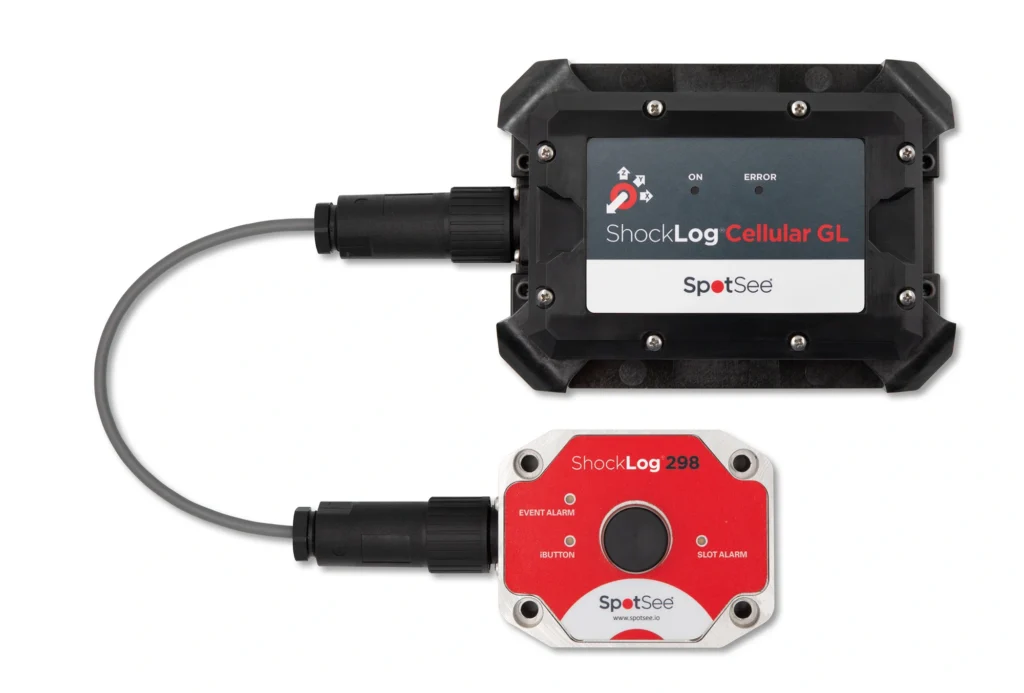
ShockLog Cellular GL and ShockLog 298: when teams need to act before delivery
It helps to separate what each part of this system does. ShockLog 298 is the data logger that records the condition of the shipment: impact events, peak values on each axis, gRMS, internal temperature, and the direction, amplitude, and duration of each event. ShockLog Cellular GL is the module that shares that condition live. A ShockLog 298 can travel on its own and record a complete history for review at receiving, but ShockLog Cellular GL depends on a ShockLog 298 to have any impact data to transmit. The cellular module turns a recorded history into a real-time alert.
Together, they cover the highest-stakes shipments. When a programmed impact level is exceeded, ShockLog Cellular GL sends a real-time alert with time, location, impact g-level, and direction, viewable through SpotSee Cloud, so a team can act before the shipment reaches the dock, arranging a replacement part or a repair rather than discovering the damage after the part is already needed on the line.
This combination is what let the instrument panel shipper, featured in our Automotive Instrument Panels and Bumpers case study, finally solve their problem. After deploying ShockLog Cellular GL with ShockLog 298, they identified the specific point in the process where panels were falling off their racks, used that evidence to educate drivers on handling, and eliminated the resulting damage and downtime. Once resolved, they simply adjusted the threshold settings on the same devices and redeployed them to monitor other components in their supply chain.
The Formula E battery supplier saw the same advantage. During the real-world test, a crate experienced an impact exceeding its set tolerance while the team was mid-flight to the next venue. By the time they landed, they already had the alert. Inspection confirmed the battery was irreparably damaged, and because the team already knew, a replacement was shipped immediately, saving the race team from a shortage on race day. Based on that result, the supplier purchased additional ShockLog Cellular GL units, each paired with a ShockLog 298, along with SpotBot GL units for all 12 racing teams and has since reduced its expedited shipping costs.
ShockLog Cellular GL with ShockLog 298 fits high-value, long-distance, or just-in-time shipments, where a damaged part arriving without warning costs production downtime or a missed delivery window, not just the part itself
A simple decision framework
Choosing between these three levels comes down to three questions.
- What happens if this part arrives damaged? A quick reject-and-replace at receiving points toward ShockWatch 2 QR. A production line disruption or a missed delivery window points toward a higher tier.
- When does the team need the information? A pass or fail signal at receiving is enough for ShockWatch 2 QR. A full environmental record for an investigation or carrier conversation calls for SpotBot GL. A need to act before the shipment arrives calls for ShockLog Cellular GL with ShockLog 298.
- How complex is the shipment journey? Short, single-leg movements between nearby facilities are well served by a visual indicator. Long, multi-leg, multi-carrier journeys benefit from a logged, time-stamped, or real-time record.
Monitoring solutions can work together
Different parts in the same supply chain carry different levels of risk, so they do not all need the same visibility. Many automotive manufacturers deploy multiple monitoring solutions side by side: ShockWatch 2 QR on high-volume, lower-risk parts, SpotBot GL on sensitive components moving through multi-leg routes, and ShockLog Cellular GL with ShockLog 298 on parts where a missed delivery is genuinely costly. The instrument panel case shows this in practice. Once the original problem was solved with ShockLog Cellular GL + ShockLog 298, the same tool was redeployed to monitor other damaged components rather than treated as a one-time fix.
The goal is not to monitor every shipment the same way. It is to match the monitoring solution to the part, the journey, and the operational decision it supports.
Frequently asked questions
What is the difference between ShockWatch 2 QR and ShockLog Cellular GL?
ShockWatch 2 QR is a single-use visual indicator that shows whether an impact exceeded a set threshold, with a QR code that links to a damage report at receiving. ShockLog Cellular GL is a connected monitoring system that records a detailed impact history through a ShockLog 298 data logger and transmits real-time alerts as events happen. The QR indicator answers a yes or no question at the dock. ShockLog Cellular GL answers when, where, and how severe, while the shipment is still in transit.
Do I need ShockLog 298 and ShockLog Cellular GL, or just one?
ShockLog 298 is the data logger that records the shipment’s condition, and it can travel alone if a reviewable history at receiving is all that is needed. ShockLog Cellular GL is the module that shares that condition live, and it requires a ShockLog 298 in order to have data to transmit. If real-time alerts matter, the two are used together.
Can SpotBot GL replace ShockLog Cellular GL for high-value parts?
Both are real-time connected devices, so the choice is not about immediacy. It comes down to data depth and cost. SpotBot GL tracks impact, temperature, and humidity, but it records fewer data points and less granular detail than ShockLog Cellular GL paired with ShockLog 298, at roughly one quarter the price. For parts where a general read on conditions is enough, SpotBot GL is the more cost-effective choice. For parts where the level of impact detail, direction, and event-by-event history matters, and the cost of ShockLog Cellular GL with ShockLog 298 is justified by the value of the part, that combination is the better fit.
Why do component racks that pass impact testing still arrive with damaged parts?
Lab testing evaluates packaging and racks under controlled, repeatable conditions. Real-world handling introduces variables that lab testing does not capture, including driver behavior, handoff points, and loading patterns. Monitoring the actual shipment is the only way to identify which real-world variable is causing damage, which is why one automotive company continued to see damage even after their racks passed standard testing.
Is impact monitoring only useful for high-value parts like batteries?
No. High-value or safety-critical parts typically justify real-time monitoring like ShockLog Cellular GL, but high-volume, lower-cost parts still benefit from basic visual indicators like ShockWatch 2 QR. The goal is matching the level of monitoring to the consequence of damage and the complexity of the journey, not applying the same solution to every part.
Can these monitoring solutions help identify which carrier or handling point is causing damage?
Yes. SpotBot GL and ShockLog Cellular GL both offer time and date stamped threshold violation, making the event traceable to a specific point in the shipment’s journey. This is what allowed one automotive company to identify the exact cause of instrument panel damage and address it directly with drivers, rather than guessing at where in the supply chain the problem originated.
—
You might also like:


